
BONNIE GUITAR
Dark Moon
She was one of the few women who led the charge in the Pacific Northwest's music production field during the 1950s. Bonnie Buckingham worked with country, pop and rock and roll artists while performing live in public, building her own archive of recordings as Bonnie Guitar (named as such for the Gibson and Gretsch electric guitars she was seldom seen without). As co-owner of the Seattle-based Dolton Records, she produced hits for vocal trio The Fleetwoods and signed other acts (instrumental rockers The Ventures chief among them), though it took several steps to get to this phase of her career.
Her earliest years were spent in Redondo Beach, south of Seattle on the banks of the Puget Sound, before the family moved several miles east to Auburn, a small farming town. Bonnie was six in 1929 when the Great Depression began and was fascinated with the family guitar though her mother, Doris, didn't approve. Her father, John, on the other hand, was pleased to see his daughter taking an interest in music. As a fiddler, he performed at local events and later brought young Bonnie along to impress the crowds with her playing. At age 13, in 1936, she participated in talent competitions using the name Bonnie Lane. Around 1943, Paul Tutmarc (a technical innovator who'd created the Audiovox 736 bass guitar in the mid-1930s) began tutoring her, coincidentally the same time he was divorcing his wife of more than 20 years. Bonnie married him the following year (he was 48, she was 21) and they moved up the road to Renton, performing together all around Seattle. In 1950 they had a daughter, Paula Tutmarc.
In 1944 they joined country band The K-6 Wranglers (sometimes spelled K-VI Wranglers after their association with radio station 570 KVI) and were regularly featured on the band's weekly show. A K-6 Wranglers single, "Two-Timin' Woman," was written by Bonnie and released on Morrison Records in 1948. More records followed in the early '50s including "Cowboy's Serenade," a country ballad by Paul Tutmarc and the Wranglers on the Rainier label, giving writing and vocal credit to Bonnie Tutmarc; Paul backed Bonnie's singing on a steel guitar he designed on this and another Morrison disc ("You Ain't 'Shamed") and other recordings on the Rainier label like "Midget Auto Blues," also with vocals by Bonnie using her married name. Two years later she released a solo single on the Listen label, "Don't Blame Me," credited to Candy Wayne. The two divorced in 1955, just before Bonnie's career took a big step forward.
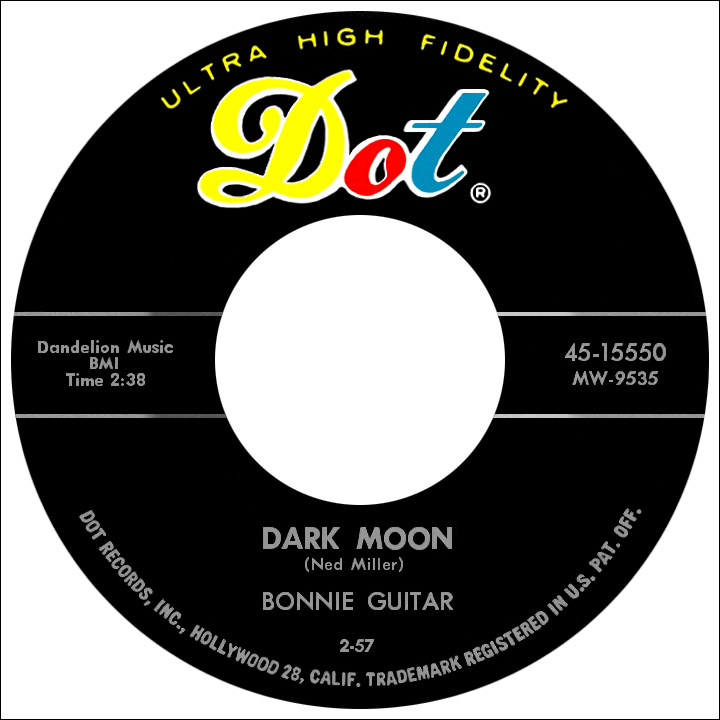
Arkansas native Fabor Robison had founded the Abbott record label in 1951, where he developed rising country acts like Johnny Horton, Jim Reeves, Mitchell Torok, The Browns, Ginny Wright and others. Bonnie sent out a demo and he signed her based on her smooth vocal sound and exceptional guitar playing; she was known as Bonnie Guitar from that point forward. "Clinging Vine," a duet with actor-singer Lee Gotch was followed by her first solo effort, the self-penned ballad "Hello, Hello, Please Answer the Phone," both singles issued on secondary Abbott label Fabor. The big breakthrough came with Ned Miller's song "Dark Moon." Dorsey Burnette struggled with the song, so Robison gave Bonnie a shot at it, impressed with the delicately-rendered result ('...a-way up high, I wonder why, I wonder why, I wonder why you've lost your splendor...'); he released her version on Fabor Records in January 1957. Deejays didn't take much convincing as airplay took a rapid rise and Robison made a deal with Randy Wood at Dot Records for wider distribution.
Within a few weeks, Wood made a move that Robison hadn't expected: his top female star, Gale Storm, recorded a cover of the song (a film actress of the '40s, she'd made her mark in television with the popular sitcom My Little Margie from 1952 to '55 and a second hit series, The Gale Storm Show, that coincided with her singing career). While covers were very common in those days, it was unheard-of for two versions of the same song on the same label to compete head-to-head. Both were actively promoted to the pop market by Dot - sheet music was even sold with photos of Bonnie and Gale side-by-side. Bonnie entered first in April, Gale made the charts a week later and both were in the top ten by June, though the Storm version remained there through July. The real winner was Ned Miller, who netted a double dose of songwriting royalties.
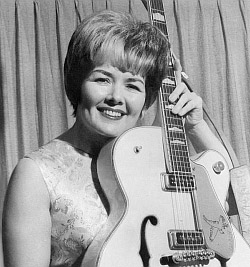
Bonnie had achieved something rare among solo female artists, hitting both the pop and country charts simultaneously (Patsy Cline had done it just a few weeks earlier with her breakthrough hit, "Walkin' After Midnight," while three years before that, Jean Shepard led the way with "A Dear John Letter," though her achievement came as a duet with Ferlin Husky). Bonnie was in demand for a brief time, appearing on TV's American Bandstand and The Ed Sullivan Show with her stunning Gretsch White Falcon guitar and touring with rock and rollers like Jerry Lee Lewis, Gene Vincent and The Everly Brothers. "If You See My Love Dancing," an orchestrated pop ballad penned by Bonnie, disappointed as a follow-up, but "Mister Fire Eyes," a bouncy mid-tempo number composed by Ned and Bonnie, sent her back to the national charts between September '57 and January '58. Several more Dot singles with various tempos and using different songwriters brought little result; Robison also issued two 45s of previously-recorded songs on his new Radio label.
In 1959 she went back to Seattle, determined to follow her creative heart: writing, producing, singing, playing and one larger goal, owning a record label. Forming Dolphin Records with refrigerator salesman Bob Reisdorff and record distributor Lou Lavinthal allowed her to call the shots in studio sessions (at Joe Boles' infamous basement studio on Admiral Way) and she immediately proved her worth. Olympia-based trio the Fleetwoods were signed to the label and before the end of the year, Bonnie had produced two number one hits for them, "Come Softly to Me" and "Mr. Blue." After the first was released, she became aware of John Dolphin's operation in Los Angeles, consisting of a 24-hour record shop frequented by L.A.-based R&B stars of the era and two successful labels (Recorded in Hollywood and Cash); to avoid any legal entanglements, the Dolphin name was changed to Dolton (though the "fish logo" designs on the labels remained) and all successive Fleetwoods singles were on the label, as well as instrumental group The Ventures, singer Vic Dana and a number of other regional acts.
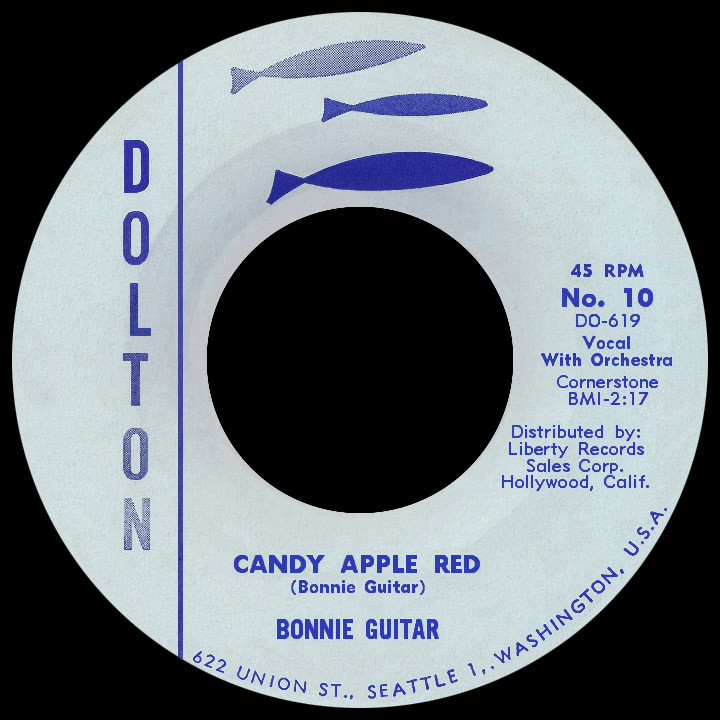
A red 1956 Ford Fairlane Skyliner 500 convertible Bonnie owned was inspiration for "Candy Apple Red," a late '59 single on Dolton that was a hit in Seattle and several other radio markets. After about a year, Reisdorff decided to move the operation to Los Angeles, but Bonnie stayed and with Jerry Dennon founded Jerden Records, though it went out of business after about a year when Dennon was drafted (he would revive it a few years later). She went to L.A. and put out a couple of country ballads on RCA Victor in '61 and '62 ("I'll Step Down" and "Broken Hearted Girl") then, returning to Washington, did some studio work while spending quality time the next few years with her husband and daughter, who by then had become interested in singing. In 1965, Bonnie produced an acetate demo of Paula (under the name Tamara Mills) at the United Recording Studio in Los Angeles. She also took a job in A&R with her old label, Dot.
One of her first moves was to sign Paula, age 15 at the time, who'd decided on the professional name Alexys; her first Dot single in late '65 was a catchy folk-pop tune, "Freedom's Child" (credited to Bonnie and "Alexys Guitar" as songwriters). The song was a hit at only two radio stations: KJR and KOL, both in Seattle. On New Year's Day 1966, Alexys was booked as an opening act for The Beach Boys at the Seattle Center Coliseum (The Yardbirds, Gary Lewis and the Playboys and The Beau Brummels were also on the bill). Alexys alternated between slightly-rocking, nearly-country and teen-pop styles. She followed her debut Dot disc with a self-titled album and two other singles, "Cold and Lonely Room" and "Big Wayne," in addition to "Gretl," credited to Canterbury Tales featuring Alexys and Gary Ballor. At about the same time, Bonnie's stepson Bud Tutmarc made an album for Dot, Rainbows Over Paradise, an instrumental collection of steel guitar tunes, followed by about two dozen more LPs of Hawaiian music and spiritual songs for various smaller labels over the next few decades.
Bonnie started 1966 with her own Dot single "I'm Living in Two Worlds," a top ten C&W hit that reached the pop charts as well. It was all the indication she needed to jump back into recording on a regular basis. Focusing strictly on country music, she scored nonstop hits the next few years with cheatin' guy song "Get Your Lie the Way You Want It," tragic-triple-death war story "The Tallest Tree," relationship abuse protest "The Kickin' Tree," I'll-leave-him-for-you offer "You Can Steal Me," can't-go-on-living "Stop the Sun" (in other words, all the good stuff country songs are made of) and two more top tens, "A Woman in Love" (in '67) and "Believe in Love" (in '68).
Ranking as one of the most successful country singers of the late 1960s, she remained with Dot through the rest of the decade, then recorded in the '70s for Columbia, MCA and 4 Star, racking up a few more country chart singles along the way. Eventually she and second husband Mario DePiano moved back to Washington State and purchased an 80-acre ranch in Sumner where they raised cattle and horses. Later she moved to Central Washington and appeared for many years at the Notaras Lodge in Soap Lake. Bonnie Guitar spent her entire life (at least since age six) indulging in musical pleasures on a daily basis...and occasionally driving around in the car she owned for decades: her "Candy Apple Red" Skyliner convertible!