
THE McGUIRE SISTERS
The life of a showgirl can often play out in unimaginable ways. A youngster with dreams and talent to match (or even surpass) could after, say, two decades find herself the most successful singer in the entire world, a billionaire with a husband who's one of football's biggest stars. Or...those dreams might yield different results. Near-instant fame, top-selling tunes and bankrolls in the millions (with an "m," not a "b") could take a trio of talented singers down a more tenuous path...with a chance one of them might unwittingly become a gangster's girlfriend. I'll save you the suspense; she didn't end up digging her own grave in the desert outside Las Vegas. The McGuire Sisters are one example (there are others that fit the same imprecise description); no one paid dearly for the indiscretions of Ruby (or Christine or Chris if you prefer), Dorothy (also known as Dottie, alternately as Dot) and especially kid sis Phyllis. Adult life for these churchgoing children was just...stressful at times.
The McGuire family lived in Middletown, Ohio, about 30 miles north of Cincinnati. Dad (Asa McGuire) was a steelworker and mom (Lillie) served as pastor of the First Church of God in Miamisburg, about 15 miles further north, just south of Dayton. In 1935, Ruby (age nine), Dorothy (age seven) and Phyllis (she was only four) began singing in the church choir, showing off harmony skills that might take others years to develop; as teenagers (or not quite a teen in Phyllis's case) they were constantly busy making appearances at area events, sticking with gospel and spiritual music, though they secretly listened to secular artists (like The Andrews Sisters, no surprise) when parents weren't lurking.
Ruby had gotten married in 1942 while still in school (divorce came in 1950). After she and Dorothy (not to be confused with the movie actress of the same name) graduated from Middletown High, the family moved closer to where the church was. Phyllis graduated from Miamisburg High School in 1949 and shortly afterwards the sisters spent nine months with the USO, singing at military hospitals throughout the U.S. After returning, they performed live on the radio each week from their mother's church (broadcast on Cincinnati's WLW-AM 700), became in-store models for Rike's Department Store in downtown Dayton, gave performances on various variety shows broadcast on WLWT-TV channel 5 and were hired as performers in the Mayfair Room at Dayton's Van Cleve Hotel, singing there every night for 22 weeks. Phyllis, whose natural vocal skill included being able to sing in any key, made her the obvious choice for lead. The girls had few, if any, issues with ego.
The hotel's Vice President, Claude J. Cannon, was so impressed by their act and the packed crowds at every show that he took them to New York City to try landing a spot on CBS-TV's high-rated competition show, Arthur Godfrey's Talent Scouts. Cannon strolled out and gave Godfrey the sisters' background; Ruby, Dorothy and Phyllis (who despite her age was always positioned in the middle) were 26, 24 and 21 on the night the show was broadcast, December 1, 1952, each standing five-foot-seven-to-eight (give or take a fraction of an inch), ready to sing with harmonious precision. If mid-century superstar Jo Stafford had seen and heard them singing her recent chart-topper "You Belong to Me" that evening, she might have uttered something like "Here comes some serious competition!" The reaction from the audience peaked the applause meter. Afterwards, several appearances on The Kate Smith Hour made them a regular sight in family living rooms across the continent.
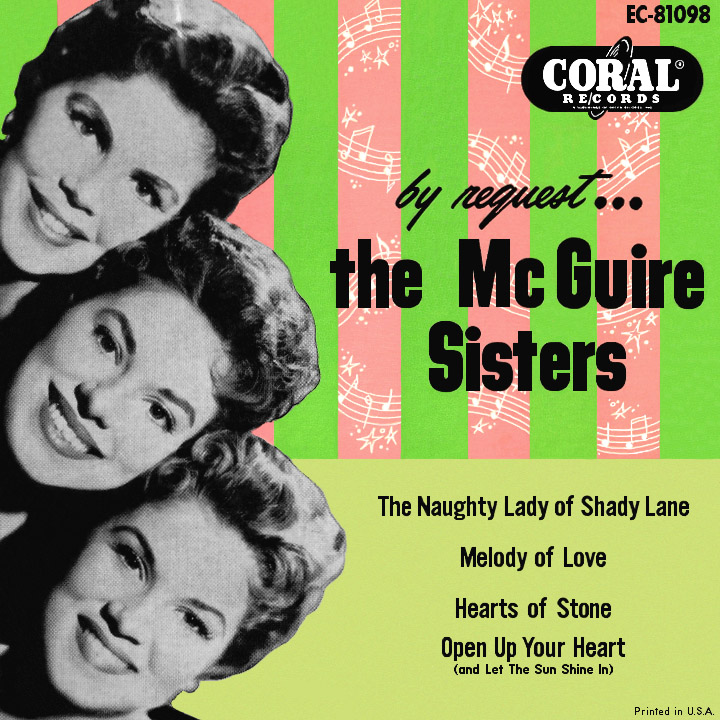
Within weeks they were signed to a recording contract with Coral Records (a Decca subsidiary). Ruby decided to use her middle name, Christine, from this point onward. They dressed and kept their hair identically coiffed onstage and at photoshoots, but made a point to look different when together in real life. All three were married at the time; Phyllis had walked down the aisle with Cleveland-area broadcast announcer Neal Van Ells in November 1952, shortly before the appearance on Godfrey's show. Dorothy signed the certificate in 1951 (it would end in '56) and Christine had started her second go-around (which ran out of gas about ten years later). Amorous entanglements were destined to become more complicated with the passage of time.
The early singles credited them as Three McGuire Sisters, a term Godfrey had used on the audition show (as a way, perhaps, to make it clear they were three distinct, albeit similar-sounding, harmony singers in order to avoid confusion with current sensations Patti Page and Mary Ford, whose voices had been double-tracked on recent hits). "One, Two, Three, Four" came across a little more mature-sounding than was evident on Talent Scouts; with the next two, "Tootle-Loo Siana" and "Tell Us Where the Good Times Are" (with vocalist Art Lund), the siblings seemed to be settling into their comfort zone while taking on older-style arrangements. Fans often asked, "Are you triplets?" and the "Three" prefix was dropped (though the question kept coming). With "Are You Looking For a Sweetheart," orchestra director Neal Hefti brought them closer to what audiences had heard the night the meter hit the max.
"Pine Tree, Pine Over Me" placed the trio in a backing (but credited) role with lead singers Johnny Desmond and Eileen Barton; it managed a brief chart appearance in April 1954, an encouraging but minor development after nearly a year and a half of trying. Any thought of competing with Jo or Patti or the other leading female acts of the day must have seemed like a pipe dream. But then the McGuires made a turn into a more contemporary mindset, taking a path others had found success with; Vee-Jay Records' rhythm and blues quintet The Spaniels made a strong showing that spring of '54 with "Goodnite, Sweetheart, Goodnite," penned by members "Pookie" Hudson and Calvin Carter. The song's romantic adieux was a solid fit for the girls, who took their respelled Coral release "Goodnight, Sweetheart, Goodnight" to the popular sales chart's top ten during the summer. A pair of back-to-back hits in the fall of '54 came from disparate sources: "Muskrat Ramble," previously a hit in 1926 for Louis Armstrong, and "Lonesome Polecat," a 'meee-owww!!' moment from the popular musical film Seven Brides for Seven Brothers.
Gaining exposure on many of the TV variety shows of the era, the girls became a welcome sight to viewers (practically everyone in America indulged in the nation's new national pastime...if, that is, they could afford to spend a few hundred bucks on a set). They often joined Ed Sullivan's Sunday night carnival of performers starting in 1953, as did Godfrey and Perry Como later in the decade. In between they made the rounds; there was no shortage of weekly variety shows. Frank Sinatra, Dinah Shore, Steve Allen, Pat Boone and Jack Benny welcomed them, always showing up in stylish, matching outfits, the same hairstyle and vocal expertise that appeared to come easy.
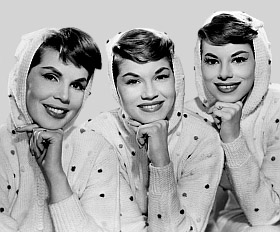
In late '54 they found another beautiful ballad riding high on the R&B popularity lists: "Sincerely," recorded by The Moonglows for Chess Records and written by the group's lead singer Harvey Fuqua (with Alan Freed credited for his contribution, how much or little it may have been). The McGuire cover (Dick Jacobs at the orchestral helm as with many of the earlier efforts) debuted on the pop charts in January 1955, just as the original was peaking; Chris, Dot and Phyllis's take went all the way to number one, where it stayed throughout February and March, its popularity lasting even longer with the disc jockeys who catered to the whims of mostly-white listeners. No matter how you slice it, "Sincerely" was one of the decade-defining standards of rock and roll's formative decade. As a hedge-bet, the group had backed the single with a cover of fellow sibling group The DeJohn Sisters' "(My Baby Don't Love Me) No More" (or simply "No More" on the McGuire single); turns out the insurance wasn't necessary, though the flip reached the top 20 anyway.
Hits came at a quicker pace for the next few years. Ivory Joe Hunter always had a knack for pop-type ballads and "It May Sound Silly" was pegged as a good fit for the sisters, landing in the top 30 in March while "Sincerely" continued riding high. "Something's Gotta Give," a vigorous number from the Fred Astaire flick Daddy Long Legs, shared space in the top ten for several weeks that summer with a version by Sammy Davis Jr. A similar situation ensued a few months later with Al Hibbler; both head-to-head covers of the gospel-pop song "He" came out winners. Meanwhile, Phyllis divorced Van Ells in '56, never to marry again or have any children.
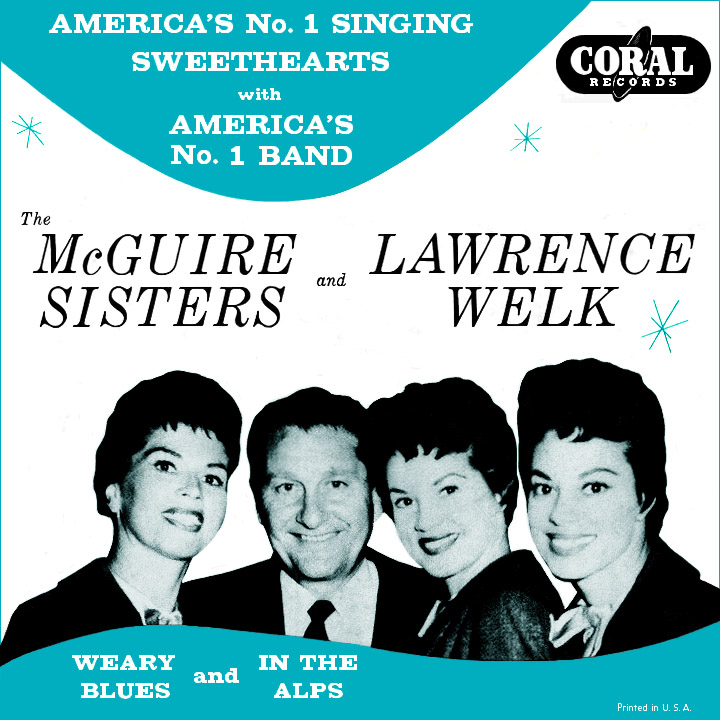
A double-sided platter scored in '56: their sound was brassier than usual on "Delilah Jones," built upon Elmer Bernstein's theme music for The Man With the Golden Arm, paired with lyrics by Sylivia Fine that had nothing to do with Otto Preminger's drug-withdrawal movie featuring a convincing performance by Frank Sinatra. It was backed with a vocal version of the theme from another top film, "Picnic." Another two-hits-for-the-price-of-one disc came in a collaboration with Lawrence Welk: '20s standard "Weary Blues" and "Champagne Music" ditty "In the Alps." This two-year stretch of diversity came full circle in '57 with a top 40 cover of Jesse Belvin's R&B hit "Goodnight My Love, Pleasant Dreams"...its title expanded from the three-word original.
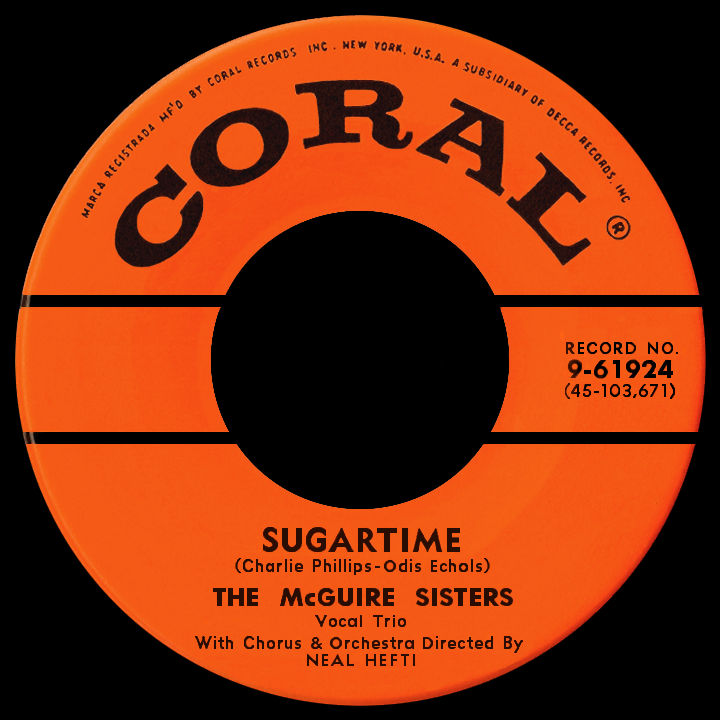
The second-biggest of all McGuire Sisters smasherooneys came from an unlikely place right under their noses. Charlie Phillips was a 20-year-old country music hopeful when he took a joy ride from his hometown, Farwell, Texas, about ten miles to Clovis, New Mexico to hit up Norman Petty at the Nor Va Jak studio about making some records. "Sugartime," a song he wrote with Clovis native and local deejay Odis Echols, was recorded in the fall of 1957 with hitmaker Buddy Holly, another Nor Va Jak act, playing guitar on the track. Petty made arrangements with Coral (Holly and the McGuire girls were two of the label's hottest properties) and Charlie's country tune/rockabilly bopper was released lickety-split. A few months later, label brass passed it to Christine, Dottie and Phyllis. Their infectious cover, arranged by Hefti, reached the top ten in January '58 and, once again, radio guys scross the land made sure the McGuire version soared to the top of local, and national, airplay listings.
Four years into their hit-singles-string and still going strong, the trio followed this straight-up phenomenon with a school's-out close-of-day refrain, "Ding-Dong," an English-language cover of Domenico Modugno's smash "Volare (Nel Blu, Dipinto Di Blu)" and an almost-top-ten ballad with a nostalgic theme, "May You Always." And now it's time for a commercial break: "The McGuire Sisters pause for Coke!" (and the new, larger "King Size Coke"), snagging a lucrative deal peddling Coca-Cola in an extensive series of TV ads...and they drank the delicious, addicting, caffeine-infused beverage straight from the bottle, onscreen (just like Robert Plant did 30 years later)! With this high-profile campaign and a continuous flow of television guest appearances (especially on The Ed Sullivan Show, where they were his guests once or twice each year), it just didn't seem like their impressive run of hits could be nearing an end.
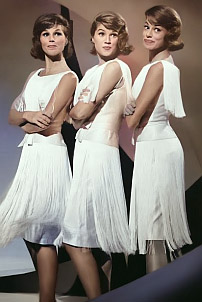
With Christine chasing Elizabeth Taylor in a race to gather and discard husbands like a very long game of bridge (Chris had five total - Liz won!), and after Dorothy found "Mr. Right," Phyllis stayed single...and proceeded to walk a figurative tightrope. In 1959 she met Sam Giancana in Las Vegas and fell head over heels with this...mob boss! Yet for a long time she was oblivious (or just "took the fifth," anyway) about what he really did for a living, turning a blind eye (the one he hooked her with, apparently) to his shadowy vocation. Any "America's Sweetheart"-type image she may have had gradually disappeared as she clung to Sam like flypaper (well, there was, perhaps, a fling with Dan Rowan of comedy team and soon-to-be TV stars Rowan and Martin...or so the scandal-mongers said and evidence backed). Giancana was based in Chicago, but spent a lot of time in Vegas whenever she was there giving fans what they came for (gambling notwithstanding).
Giancana's world existed on another plane from that of the McGuire Sisters. Their uprbringing and ascent into show business became juxtaposed against his life in the mob, involvement with gambling establishments and celebrities like Frank Sinatra (one of his nemeses), politicians like John F. Kennedy (each possessing a certain degree of celebrity status with suspicious aspects like an alleged plot to assassinate notorious Cuban leader Fidel Castro), having Rowan followed by detectives simply because he had dated Phyllis, and illegal money schemes that may or may not have covered the considerable cost of a mansion she claimed had been built with the proceeds from personal investments.
Hits were getting harder to come by (though "Just For Old Time's Sake," another new song with a nostalgic theme, made the top 20 in the spring of '61), but the sisters remained popular on the club circuit. On TV it was business as usual as they popped up in the mid-'60s on The Jimmy Dean Show, The Red Skelton Hour, The Tonight Show Starring Johnny Carson, The Hollywood Palace, The Dean Martin Show and numerous Sunday night Sullivan fests. After leaving Coral in 1963, they signed with Sinatra's Reprise label (Phyllis even appeared on the big screen as the object of one of three flings Frank has in Come Blow Your Horn), but record sales failed to materialize.
Christine and Dorothy had alluded to eventually settling down, sooner rather than later, in a 1960 Person to Person interview with Charles Collingwood and within a few years the wheels were in motion to make that reverse-ambition dream a reality. Phyllis's dream, on the other hand, was to "...stay in show business, I love it!" A few years later the sister act split up, got back together, then called it quits again while Phyllis filled the gaps as a solo act and enjoyed one minor hit in 1964, "I Don't Want to Walk Without You." It wasn't just members of the public that kept their eyes on her...for a time, the FBI basically monitored every move she made. She didn't reveal much in 1965 when a grand jury subpoenaed and questioned her about Giancana.
Ed Sullivan invited the group back repeatedly; by 1968 they'd been on the show 20 times and showed up for one final appearance in March. Then Christine and Dorothy retired from show business just as they'd planned. Phyllis lived up to her words and kept going, frequently headlining in Las Vegas. Sam Giancana, still a big part of her life, was in the Chicago area when he was shot and killed in 1975 at the age of 67. Authorities never determined who did it. Boredom must have come (and kids grew up?) by 1984 when the trio announced a comeback, picking up where they'd left off, performing around the country, though mostly in the Nevada casinos. The final McGuire Sisters appearance was on a PBS television special, "Magic Moments: The Best of '50s Pop," in 2004.
Ruby Christine McGuire and Dorothy McGuire retired for good to Scottsdale, Arizona with, respectably, their fifth and second husbands. All three enjoyed long lives, passing away between 2012 and 2020. Phyllis McGuire, the one "in the middle" performance-wise and public-scandal-wise (but not age-wise), lived in her Las Vegas mansion for more than 50 years. Meanwhile, Charlie "Sugartime" Phillips (his nickname since scoring that one famous hit as a songwriter) had been performing in the southwest U.S. off-and-on throughout the five-decade span of "McGuire Mania." Maybe he's still at it, who knows?
NOTABLE SINGLES:
- One, Two, Three, Four - 1953
as Three McGuire Sisters - Tootle-Loo Siana - 1953
as Three McGuire Sisters - Tell Us Where the Good Times Are - 1953
as the Three McGuire Sisters and Art Lund - Are You Looking For a Sweetheart - 1954
- Pine Tree, Pine Over Me - 1954
by Johnny Desmond, Eileen Barton and the McGuire Sisters - Goodnight, Sweetheart, Goodnight - 1954
- Muskrat Ramble /
Lonesome Polecat - 1954 - Christmas Alphabet - 1954
- Sincerely /
No More - 1955 - Open Up Your Heart (And Let the Sun Shine In) - 1955
- The Naughty Lady of Shady Lane - 1955
- It May Sound Silly - 1955
- Something's Gotta Give - 1955
- He - 1955
- Give Me Love - 1955
- (Baby, Baby) Be Good to Me /
My Baby's Got Such Lovin' Ways - 1956 - Missing - 1956
- Delilah Jones /
Picnic - 1956 - Weary Blues - 1956
by the McGuire Sisters and Lawrence Welk / - In the Alps - 1956
by the McGuire Sisters and Lawrence Welk - Ev'ry Day of My Life /
Endless - 1956 - Goodnight My Love, Pleasant Dreams - 1957
- Kid Stuff - 1957
- Around the World In 80 Days - 1957
- Sugartime - 1958
- Ding Dong, Ding Dong - 1958
- Volare (Nel Blu, Dipinto Di Blu) - 1958
- May You Always - 1959
- Summer Dreams /
Peace - 1959 - Livin' Dangerously - 1960
- The Last Dance - 1960
- Just for Old Time's Sake - 1961
- Tears on My Pillow - 1961
- Just Because - 1961
- I'm Just Taking My Time - 1962
- Sugartime Twist - 1962
- Summertime (Is the Time For Love) - 1963
- Candy Heart - 1964
- I Don't Want to Walk Without You - 1964
by Phyllis McGuire - Truer Than You Were - 1966
- Just a Little Lovin' - 1968
by Phyllis McGuire