
THE BACHELORS
Unlike the majority of top-selling rock and roll-inspired groups from Great Britain in the early- to mid-1960s, The Bachelors chose a more traditional pop approach, reviving ditties from decades gone by...and were successful at it for a good half-decade. When Decca Records' A&R director Dick Rowe said, "Stick to what I say...just record oldies," they complied; Rowe gave the same advice to The Rolling Stones, who replied with whatever crude Brit slang that could be easily interpreted as "No way!" On the other hand, Irish brothers Conleth "Con" Cluskey and Declan "Dec" Cluskey, along with pal John Stokes, had been brought up in a more traditional musical mindset (they'd begun as an instrumental harmonica act!) and such a setup seemed quite natural to them. So off they scampered to the years between the two World Wars, scoring several big singles applying their sound to songs that were, perhaps, even a little before their parents' (but not grandparents') time.
Forming as The Harmonichords while in high school, vocal considerations were disregarded; the brothers were pretty sharp on the harp while John straddled a double bass. All three attended Dublin's O'Connell School; Con studied mechanical engineering, while Dec was more inclined to gamble on making it as an entertainer. John, who was slightly older than the brothers, actually worked for a time in the civil engineering field. As for any dreams of a career in the music industry, their parents disapproved but had little or no say after graduation. A four-week stint on ITV's Opportunity Knocks with former kids' show yakker, bit-part actor and star game show host Hughie Green, helped get the guys rolling. Keeping noses to the musical grindstone the next two years, a 1959 St. Patrick's Day edition of American series The Ed Sullivan Show (partly filmed in Dublin) turned into a great opportunity. The trio performed a rendition of "Danny Boy" on the show, giving them cross-Atlantic exposure.
They began singing in harmony...and were pretty good at it! Belfast-based music manager Philip Solomon (who had connections at Decca Records) took notice. A monthlong 1961 tour opening for Danish duo Nina and Frederik (who'd landed in the U.K. top ten with a seasonal song, "Little Donkey") preceded '62 shows in Scotland and the U.K. where they incorporated comedy bits (gleefully imitating hitmakers like Frank Ifield and Karl Denver). Dick Rowe stopped by, ready with Decca contracts. But he wanted them to change their name to The Bachelors (his reasoning? "That's the kind of boy a girl likes"); logical or not, these young, hungry blokes took him up on the offer.
Rowe arranged for the group to meet with Chicago-born producer Shel Talmy (who was ultimately far more successful with British acts than American ones). It was decided the first single would be "Charmaine," a song written in 1926 by Hungarian Ernö Rapée and American Lew Pollack, a hit that year for Canadian bandleader Guy Lombardo. The trio performed the song on New Year's Day 1963 on the premiere episode of the BBC's 6.25 Show, hosted by actor Jimmy Young, and it did the trick; the disc spent much of March and April in the top ten of the Irish and English charts. "Faraway Places" (penned by real-life lovebirds Alex Kramer and Joan Whitney, it had been a 1949 hit for Margaret Whiting, Perry Como and Bing Crosby) got the guys back into the U.K. top 40 that summer and "Whispering" (a massive seller for Paul Whiteman in 1920) reached the top 20 in November. Appearances on the most popular TV shows (Ready Steady Go and the latest, Top of the Pops, which premiered on New Years' Day '64) encouraged Rowe and willing producer Talmy to scour the "olden days" for more material.
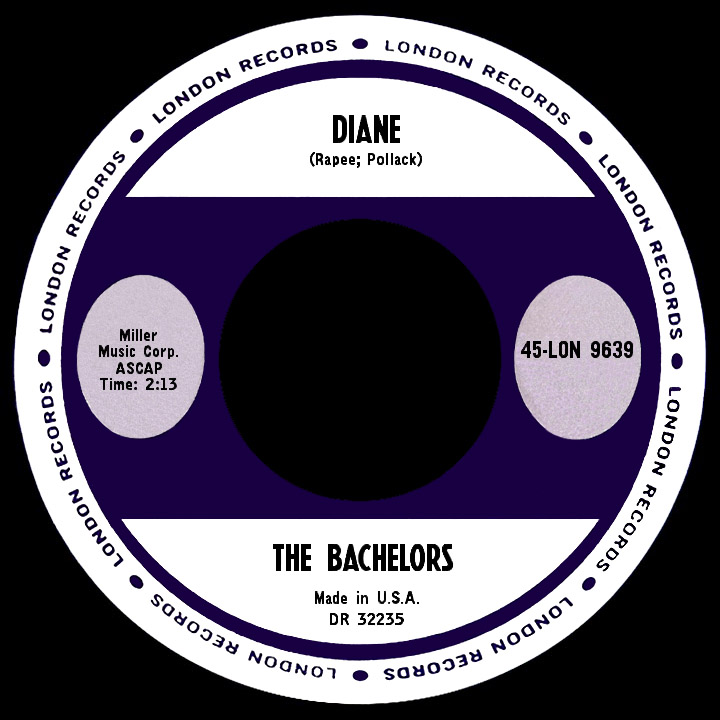
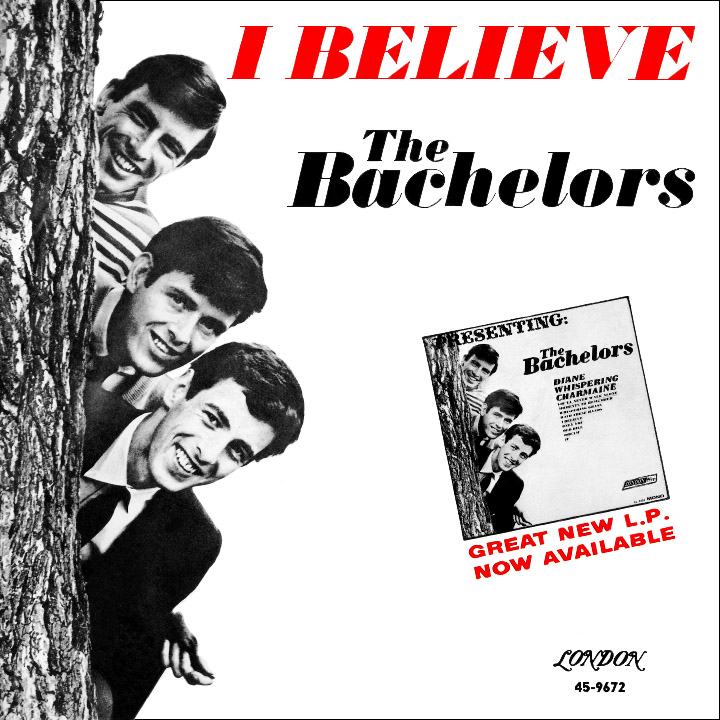
"Diane," another Rapée-Pollack song, had been the theme for the 1927 film 7th Heaven (starring the inaugural Best Actress Oscar winner, Janet Gaynor). The Bachelors' version climbed quickly up the U.K. charts, spending a couple of weeks at number one in late February 1964, just as The Beatles were finally wreaking havoc in the U.S. (and many other global spots), a turn of events that broke them in the western hemsiphere. The single hit the U.S. top ten in June and also went top ten on Billboard's Easy Listening chart, a place the Bachelors would return to several times. "I Believe" (first recorded by Jane Froman in 1952 and even more successfully by Frankie Laine the following year) was the group's third U.K. top ten and second U.S. top 40, produced by another American, Marvin Holtzman, transplanted from Philadelphia. The next three singles ("Ramona," the title tune from a 1928 film, followed by "I Wouldn't Trade You for the World" and "No Arms Can Ever Hold You") each made the top ten in the trio's homeland while having varying success in the States.
Appearances in movies were on the slate for '64 and '65. It's All Over Town starring British singer Frankie Vaughan featured performances by Mr. Acker Bilk, The Springfields and The Hollies with the Bachelors added to the mix. Con, Dec and John also appeared in a vehicle for singing idol Billy Fury, I've Gotta Horse (strange title, yet it's just a wacky, sentimental comedy about Billy making a pet of a thoroughbred racehorse), and Just For You, with several hot recording acts, re-edited and released in the U.S. more than a year later as Disk-O-Tek Holiday. Meanwhile, the group returned to the British top ten in '65 with "Marie," a late-'20s Irving Berlin song that was overall their second-biggest Stateside hit, reaching number 15 in July while the Rolling Stones were perched 14 spots higher with "(I Can't Get No) Satisfaction," a quaint little milestone that had definitely not been composed some 30-odd years earlier.
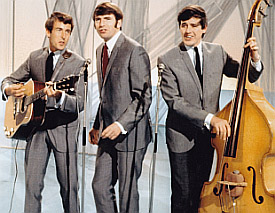
The Bachelors scored another top 40 hit in the U.S. that November with "Chapel in the Moonlight," penned by Bostonian Billy Hill, known primarily for writing songs associated with the Wild West (originally from the mid-'30s, the song had been a major hit in 1954 for Kitty Kallen). By the end of 1965, Decca estimated the Bachelors had impressively sold over ten million records; the hits kept coming in their homeland, but only for about two more years. Those include a cover of Simon and Garfunkel's "The Sound of Silence" and "Walk With Faith in Your Heart," while in between the two they did well in America with "Love Me With All of Your Heart" (their sixth Easy Listening top ten) and "Can I Trust You?" Then came the final U.K. top 20, "Marta," putting their total female-title hits at five...these sneaky married guys (two of them at the time, anyway) had definitely been catering to the ladies!
As the chart hits dwindled, their stock as a live act rose. Tours were scheduled in many countries and the three transitioned to radio...and the telly...as hosts...and actors. While contributing music to a number of variety shows on Ireland radio network RTÉ, they had their own Saturday night TV series, It's the Bachelors, running for two six-episode seasons in 1969 and 1970. In '71 they starred in Under and Over, a limited comedy sssseries on the BBC about underground railway workers moonlighting as singers in pubs. A regular sight on British TV throughout the decade, the trio often performed on popular shows like Stars on Sunday and Seaside Special. Decca canceled their contract in 1972 after ten years with the company; records appeared on Philips from 1973 to '75, then on the smaller Galaxy label through 1979.
John Stokes had been a bit of a wild card, leaving the group for extended periods a few times post-mid-'60s. In 1984 he left for good and the Cluskey brothers continued as a duo (occasionally with a third wheel). Sometimes the Cluskeys were billed as Con and Dec, the Bachelors or The New Bachelors. Stokes headed shows as The New Bachelors as well, or with Steve Coe as Stokes and Coe. They met up in the courts more than once. Ultimately, Con and Dec Cluskey carried on with the original name. And in case you were wondering: none of them had remained Bachelors for very long.
NOTABLE SINGLES:
- Charmaine - 1963
- Faraway Places - 1963
- Whispering - 1963
- Long Time Ago - 1963
- Diane - 1964
- I Believe - 1964
- Ramona - 1964
- I Wouldn't Trade You for the World - 1964
- No Arms Can Ever Hold You - 1965
- True Love For Evermore - 1965
- Marie - 1965
- Chapel in the Moonlight - 1965
- Hello, Dolly! - 1966
- The Sound of Silence - 1966
- Love Me With All of Your Heart - 1966
- Can I Trust You? - 1966
- Walk With Faith in Your Heart - 1967
- Oh How I Miss You - 1967
- Marta - 1967
- Learn to Live Without You - 1967
- The Unicorn - 1968
- Punky's Dilemma - 1969
- Love is All - 1969
- (All of a Sudden) My Heart Sings - 1970