
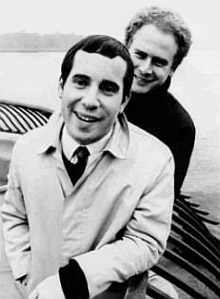
SIMON AND GARFUNKEL
About seven years had gone by since Paul Simon and Arthur Garfunkel, teenage fans of early rock and rollers like The Every Brothers and The Sparkletones, had started making music together. Scoring a mid-size hit in late 1957 with "Hey, Schoolgirl" brandishing the psudonym Tom and Jerry, they quickly learned what so many others knew: a second hit would be hard to get. The duo made a few more tries then veered off onto separate routes, recording under monikers like (in Art's case) Tommy Graph or Artie Garr and (in Paul's case) Jerry Landis or True Taylor or Paul Kane, each struggling to find success outside a couple of Paul's charting side projects: singing lead for Tico and the Triumphs ("Motorcycle") and solo as Landis ("The Lone Teen Ranger"). Reconnecting around 1964 they agreed, for better or worse, to use their given names. People said they would never catch on as Simon and Garfunkel and initially those naysayers appeared to be right.
After high school graduation in 1959, Art took architecture courses at Columbia University in Manhattan, not far from the offices of the small record labels he still recorded for. At one point Paul was hired by music publisher E.B. Marks to personally demo some of their more promising songs to record companies; he would also slip in an occasional unpublished song he'd written. The two ran into each other in Queens one day and decided to give it another go. Paul's determination got him in the door at Columbia Records where Texas-born, jazz-focused producer Tom Wilson showed interest, seeing him as a potential folk music successor to Bob Dylan, whose early albums he'd produced. Paul brought Art with him shortly afterwards as producer and engineering whiz Roy Halee got involved. Impression made; they were signed to the label.
Debut album Wednesday Morning, 3 A.M. (its cover photo shot in the midtown Manhattan subway) was recorded in the spring of '64 and released in October. By that time, Simon had moved to England for an extended stay that ultimately lasted over a year. Its liner notes, at Wilson's suggestion, were written by Garfunkel, starting with a letter to Simon, suggesting he's "in London now, goofing," while Art, still in school, is hard at work with term papers and looking forward to the time they would be reunited. The 12 songs are a mix of traditional folk tunes ("Peggy-O," "Go Tell it on the Mountain"), Dylan's already-anthemic "The Times They Are a-Changin'" and five light, acoustically-rendered originals far removed from the rockers and teen ballads of just a few years earlier, each penned by Simon: the title track, "Bleecker Street," "Sparrow," "He Was My Brother" and one other. Reviews of the album were middling and it didn't sell very well. But as fate decreed, that other song, "The Sounds of Silence," was going to change their lives. Just not right away.
"I Am a Rock," "Leaves That Are Green" and "April Come She Will" were written by Simon during his leave, recorded in a single session with nothing more than his guitar and released in the U.K. in August 1965 as a solo album for CBS, The Paul Simon Songbook. The cover showed Paul and his then-current girlfriend, Kathy Chitty (reminiscent of the cover of Dylan's Freewheelin' LP two years earlier). "Kathy's Song," another original, was written for her. "The Sound of Silence" (without the extra "s" in the title) was on the LP, differing considerably from the S&G recording (more reverb, foot-tapping and a slightly more aggressive vocal performance).
Around this time, Tom Wilson and Roy Halee decided to enhance the Wednesday Morning take of "The Sounds of Silence" by bringing in the session musicians from Dylan's electrically-enhanced Bringing it All Back Home LP. If it had worked for Bob, why couldn't it help bring attention to Simon and Garfunkel? The difference, of course, was that neither was made aware of the modification. A single was issued and it began to get radio airplay...lots of it. Word was sent to Simon to come back; he and Garfunkel got busy creating a new album. The label wanted them to put it together very quickly. By the end of the year, "The Sounds of Silence" was the nation's number one hit.
A stand-alone single, "Homeward Bound," came as a result of homesick feelings Paul had during his time away. Released as soon as "Sound" peaked, it reached the top ten in March. "That's My Story," a Tom and Jerry ballad from 1958 written by both, was re-released by ABC-Paramount in early '66 and briefly received airplay at enough stations to get it into Billboard's Bubbling Under charts. The April release of the Sounds of Silence LP coincided with the next single, the duo's rendition of "I Am a Rock." Simon's ode to isolation ('...a rock feels no pain...and an island never cries...') shot to the top ten in May, peaking at number three a few weeks later. While overseas, Paul composed "Red Rubber Ball" with Bruce Woodley of The Seekers; in the spring of 1966 it was a hit for The Cyrkle, a band managed by Brian Epstein (that's right, the guy who'd gotten The Beatles off and running). Though never recorded by S&G, it was feather in Simon's cap (and they sometimes performed the song in concert).
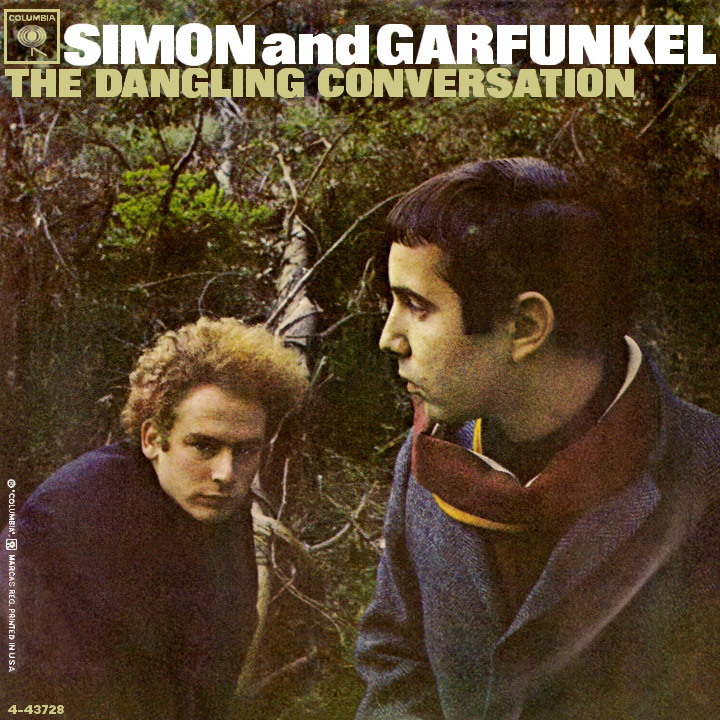
The third album, Parsley, Sage, Rosemary and Thyme, arrived in the fall of '66 with "Homeward Bound" on its tracklist and a new single, "The Dangling Conversation," a poetic ode to a passive relationship on the verge of separation (with asides to authors Emily Dickinson and Robert Frost); the song landed in the top 30, well below the top ten ranking of the previous three singles. The group's acoustic inclinations (two guys, one with a guitar) were inching towards a more electronic-based sound, exemplified by "A Hazy Shade of Winter," its lyrics suggesting a transition from youth to the next phase of life. Shortly afterwards, "Seven O'Clock News Silent Night" was issued as a promotional radio single, juxtaposing the duo's soft rendering of the classic Christmas song with a news report (military action, murder indictments, war protests), a jarring seasonal offering that resonates regardless of what year it is.
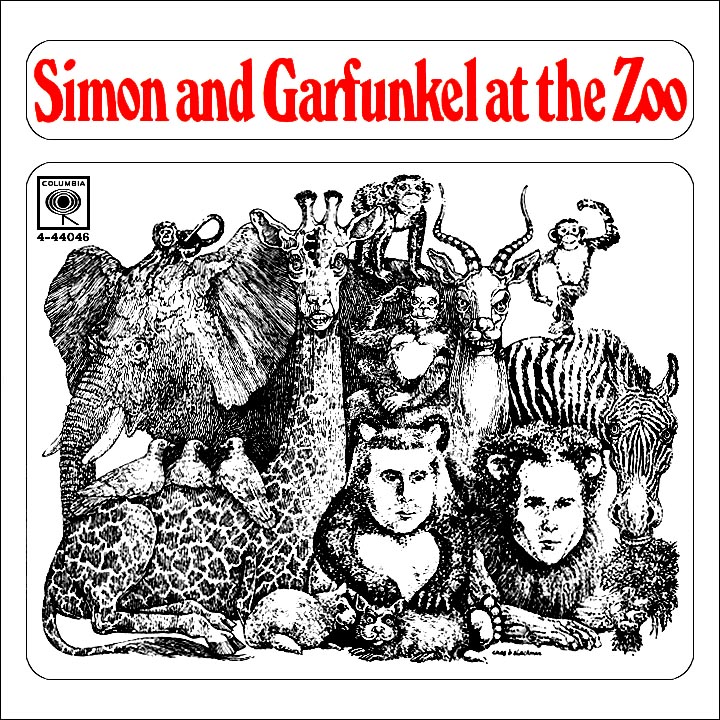
Santa Cruz, California group Harpers Bizarre covered "The 59th Street Bridge Song (Feelin' Groovy)" (a Parsley, Sage album cut) and released it on Warner Bros. in early '67 while S&G's first new single of the year, "At the Zoo," took listeners straight to where the animals were with amusing observations ('orangutans are skeptical of changes in their cages...')."59th Street Bridge" was on the "Zoo" flip side and the two singles were simultaneously in the top 20 in April. Around the same time, Johannesburg, South Africa-born Dana Valery (whose older brother was singer Sergio Franchi) recorded "You Don't Know Where Your Interest Lies" for Columbia, a song familiar to Simon and Garfunkel's concertgoers (Paul has one spoken line on Valery's version). Their own recording of the song wound up on the B side of "Fakin' It" and didn't appear on an album until the release of a couple of much-later compilations.
In early 1968 they went back to the album for the next single, "Scarborough Fair (/Canticle)," and there was a reason: Mike Nichols, a big fan of Paul and Art and director of The Graduate (actor Dustin Hoffman's star-making role and a top Oscar contender), had approached them about contributing to the soundtrack (mainly utilizing a few previous favorites including "The Sounds of Silence" and that album's "April Come She Will"). Nichols was satisfied, but something more was needed. A new composition caused more of a sensation: Paul had been working on an idea for a song called "Mrs. Roosevelt" (set many years earlier in the era of 'Joe DiMaggio') and Nichols asked him to change it to "Mrs. Robinson," after the seductive next door neighbor played by Anne Bancroft. The song reached number one in June. Two short takes are on the soundtrack album of The Graduate (the alternate "running out of gas" version is also memorable in the context of the film) and the hit version was included on Bookends (along with the three previous non-LP singles); the two albums were consecutive number one sellers from April through July '68!
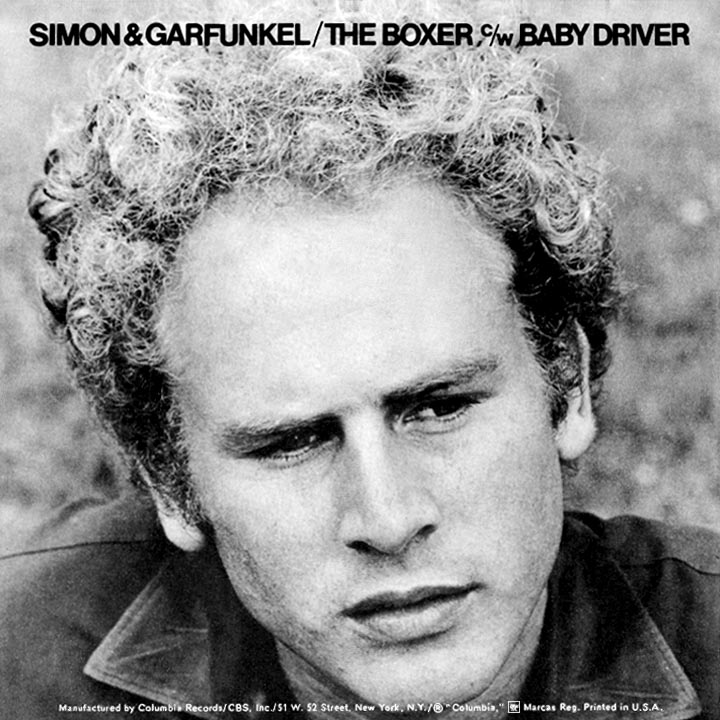
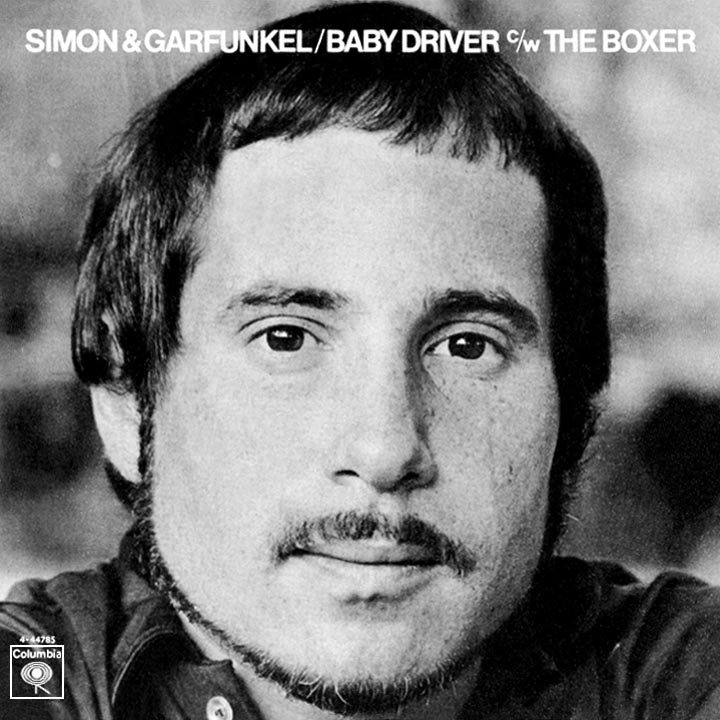
The project garnered some of the industry's top awards: Nichols won Best Director for The Graduate at the Academy Awards in April 1968. Simon and Garfunkel enjoyed a double Grammy victory almost a year later, in March '69: Record of the Year and Best Contemporary Pop Performance for "Mrs. Robinson." Nichols gave both of them acting roles in his next big studio project, Joseph Heller's World War II satire Catch-22, before Paul's character was cut by screenwriter Buck Henry. Garfunkel spent five months on the shoot (mostly in Mexico) while Paul stayed in N.Y. and worked on music for the next album. Two songs had been recorded near the end of '68 and were released as a single that spring. "The Boxer" became their fifth top ten hit; flip "Baby Driver," which received airplay on quite a few stations, was an attempt to revisit the style of their early rock and roll records. Both would be on the next album, which carried production credit to Roy Halee, Paul and Art.
Once the master was completed, the duo performed in several cities in October and November 1969 as performances and offstage footage was filmed. On November 30, 1969, CBS aired Songs of America, a documentary taken from those tour dates, which included their next hit, the album's title track "Bridge Over Troubled Water," with Art doing the lead vocal. Both single and album were number one on their respective charts through most of March, April and May 1970. Other Bridge songs were hits: "Cecilia" had a Latin flavor and loose rhythmic feel and followed the two previous singles into the top ten. Some years earlier, "El Condor Pasa" had become a favorite of Paul's, an Andean folk song recorded by Los Incas (formed in France in the early 1960s by Peruvian musicians). He wrote some new lyrics and arranged to have the group, whose members mainly played stringed instruments, to accompany him on the track.
As this was happening, there were strains on the longstanding friendship; Paul and Art no longer wanted to work together. It could have been that Paul was tough to work with (Seeker Bruce Woodley said so at some point). Or maybe Art felt he should have more input into the songwriting process (in the 1950s, they had both taken credit). Perhaps it was about Art prioritizing his dream of acting in films (though that would likely be Paul's problem, not his). Nevertheless, they both appeared onstage at the Grammy Awards the following March, when Bridge received six awards in various categories including Record of the Year, Album of the Year and Song of the Year.
Garfunkel made his second film appearance in Mike Nichols' Carnal Knowledge, starring with Jack Nicholson, Ann-Margret and Candice Bergen. He was nominated for a Golden Globe Award for Best Supporting Actor. Paul's solo career started strong in early 1972 with his first of many hits, "Mother and Child Reunion." A single was released that summer to promote their Greatest Hits LP; the plug side, "For Emily, Whenever I May Find Her," is a live recording from their '69 tour, while B side "America" (romantically set on a Greyhound bus) made its first appearance on a 45. Art's solo career took off in the fall of 1973 with a song by Jimmy Webb, "All I Know," and it reached the top ten. Roy Halee, the one person they were most comfortable making records with, continued working separately with both artists.
Then in 1975 they satisfied the public's demand for a reunion - but only briefly - with one song: "My Little Town" ('...nothin' but the dead are lyin' back' in that place...or so we've all heard!). For a change, they worked with Columbia producer Phil Ramone. There wasn't an S&G B side, though, just two solo recordings, one from each of their current LPs. NBC's Saturday Night, the long-running comedy/music/pop culture hotspot - then and now - premiered that fall and Paul clicked in that environment, appearing multiple times over the years. On the show's second episode, broadcast October 18, 1975, Art joined him and the "Old Friends" sang three songs together including the new single.
The two have mostly stayed apart, crossing paths infrequently; in 1978 they joined James Taylor on SNL to perform the Sam Cooke classic "(What A) Wonderful World," a hit for Art at the time. On September 19, 1981, the famous duo staged the The Concert in Central Park, a free event witnessed by a half-million people. A live version of "Wake Up Little Susie," originally by their idols Don and Phil Everly, returned them to the top 40 in the spring of '82. Afterwards they agreed to occasionally perform together, which occurred on and off for nearly three decades...but any friendly banter was usually just onstage. Going back to the liner notes written by Art on that first Columbia album, his reference to Simon and Garfunkel's great breakthrough hit may have taken on a new meaning concerning where these former friends, and great musical artists, have left their highly regarded collaboration: "...when meaningful communication fails, the only sound is silence."
NOTABLE SINGLES:
- Hey, Schoolgirl - 1957
as Tom and Jerry - Our Song - 1958
as Tom and Jerry - That's My Story - 1958
as Tom and Jerry - The Sounds of Silence /
We've Got a Groovey Thing Goin' - 1965 - Homeward Bound /
Leaves That Are Green - 1966 - That's My Story - 1966
as Paul Simon and Arthur Garfunkel - I Am a Rock /
Flowers Never Bend With the Rainfall - 1966 - The Dangling Conversation /
The Big Bright Green Pleasure Machine - 1966 - A Hazy Shade of Winter /
For Emily, Whenever I May Find Her - 1966 - 7 O'Clock News Silent Night - 1966
- At the Zoo /
The 59th Street Bridge Song (Feelin' Groovy) - 1967 - Fakin' It /
You Don't Know Where Your Interest Lies - 1967 - Scarborough Fair (/Canticle) /
April Come She Will - 1968 - Mrs. Robinson /
Old Friends/Bookends - 1968 - The Boxer /
Baby Driver - 1969 - Bridge Over Troubled Water /
Keep the Customer Satisfied - 1970 - Cecilia /
The Only Living Boy in New York - 1970 - El Condor Pasa /
Why Don't You Write Me - 1970 - For Emily, Whenever I May Find Her /
America - 1972 - My Little Town - 1975
- (What A) Wonderful World - 1978
by Art Garfunkel with James Taylor and Paul Simon - Wake Up Little Susie - 1982