
SLIM WHITMAN
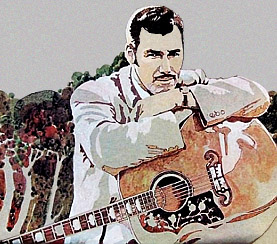
Florida's singer, guitarist and bounce-off-the-sky yodeler Slim Whitman enjoyed an unusually long career. A few well-timed turns kept his profile high and talents sharply-honed from the late 1940s throughout more than a half-century. Many today remember him for a long-running series of television commercials, usually shown late at night, that featured clips of his performances and resulted in millions in sales...likely ten million or more...of "greatest hits"-type compilations. Older folks will be able to recall his first round in the 1950s as a popular country artist, or his 1960s resurgence. One little detail is sometimes overlooked: he was much more than just a "country" artist.
Folk tunes, odes to nature, tales of the wild west and above all romantic love songs fueled his ongoing arsenal of original and traditional recordings. Born on the east side of Tampa in 1923, Ottis Dewey Whitman, Jr. (his first name pronounced "au-tis") came from a family with two brothers and two sisters but spent much of his childhood by himself, fishing at the creek or with friends playing baseball. His favorite singers were yodelers: Mississippian Jimmie Rodgers, the beloved "Singing Brakeman" of the late 1920s and early '30s, and Nova Scotian Wilfred "Wilf" Carter, who achieved fame in the U.S. on the Bluebird and RCA Victor labels as Montana Slim, the "Yodeling Cowboy" young Otiss would tour with many years later. Not to be disrespectful to such esteemed musicians (particularly the clear, fluid tones of Rodgers), but you might say the kid took the best attributes of each and ultimately upstaged them both.
A pitcher for the Hillsborough High School baseball team, Otiss dreamed of a major league career. But that goal was cut short when he met Geraldine Crist, the daughter of the local church's new minister. Married at 18, he quickly became father to a daughter and a son prior to joining the Navy at the start of World War II. During the next two years in the South Pacific on board the U.S.S. Chilton, he took up two pastimes: boxing and singing/yodeling, stringing a guitar backwards for left-handed playing. This was when he came up with the "Slim" nickname that stayed with him for the rest of his life. After the war, he returned to the Tampa area to work at the shipyard there, spending his spare time playing baseball in Plant City, the "Winter Strawberry Capital."
In 1948 he decided to pursue a music career full time with his band, The Variety Rhythm Boys; after being spotted by Colonel Tom Parker (several years before Elvis Presley became his main client), an acetate demo recorded in Tampa was sent to RCA Victor Records in late 1948 and a single, "I'm Casting My Lasso Towards the Sky," an upbeat yodel tune penned by molasses-slurping actor-singer Lee "Lasses" White and recent chart-topper Jimmy Wakely, was a minor seller in the spring of 1949. Eight sides were recorded at the Fox Theatre Building in Atlanta in February '49 and released over the next year by RCA, including sentimental ballad "Please Paint a Rose on the Garden Wall" and "Birmingham Jail" (a variation on "Down in the Valley"); the formidable lineup of musicians included future hitmakers Chet Atkins on guitar, Homer and Jethro on guitar and mandolin, Charles Randolph Grean on bass and Jerry Byrd on steel guitar.
An early 1950 session in Nashville produced a duet with Lexington, Kentucky-born Dolores Watson (known at the time as a singer on Sunday Down South, broadcast on AM 650 WSM and nationally on the NBC radio network); "Let's Go to Church (Next Sunday Morning)," the first successful composition by Steve Allen, covered a hit version by Wakely and Margaret Whiting. That summer, Slim was a guest singer on the Mutual Network radio series Smokey Mountain Hayride, which led to his own limited-run show, Slim Whitman and the Lightcrust Doughboys. In the spring of 1950 he joined The Louisiana Hayride, its home base in Shreveport on AM 850 KWKH, but despite the show's popularity, the pay wasn't great. For a time, he moved his family to Shreveport and worked at the local post office to make ends meet.
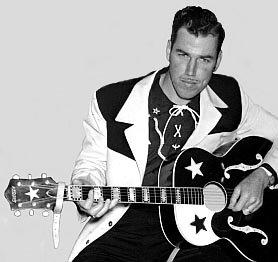
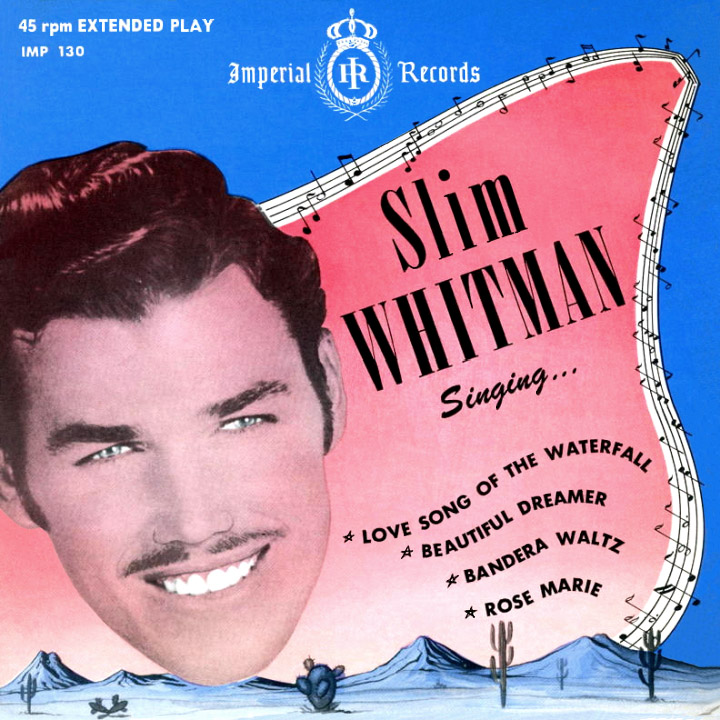
In late 1951, Whitman (who'd been without a label for nearly a year) was signed to Lew Chudd's Los Angeles operation, Imperial Records, where he remained for nearly two decades (lasting beyond Chudd's ownership of the company). Billed as "The Smilin' Starduster," Slim's yodeling expertise was used to fine effect on his debut Imperial disc "Love Song of the Waterfall," a tune written several years earlier by Bob Nolan of The Sons of the Pioneers. The song features an unusual effect not heard before: steel guitarist Hoot Rains experimented (sometimes accidentally) while playing, finding he could get what came to be described as a "shooting arrow" sound. Afterwards it was used often in Slim's performances (and imitated by other artists).
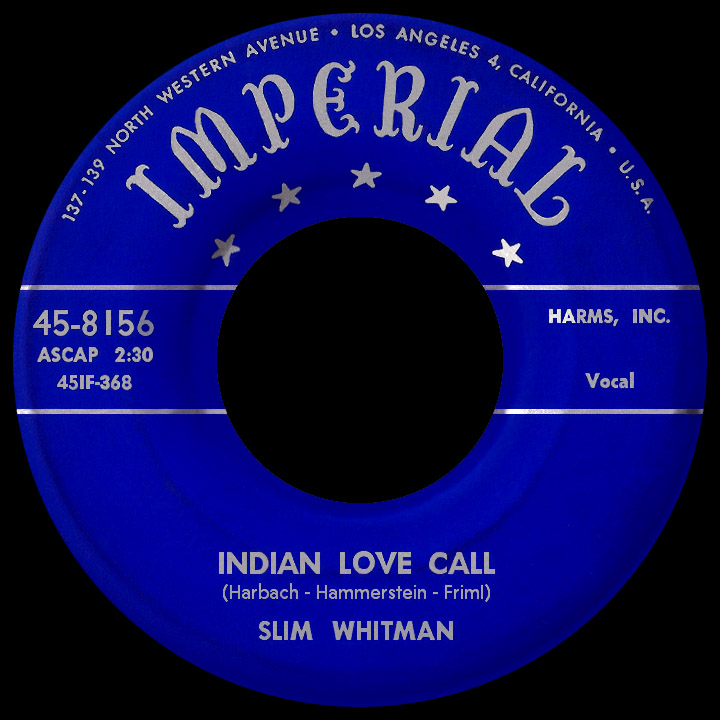
The next release had a strong run on the charts in the summer and fall of 1952. "Indian Love Call," by Czech composer Rudolf Friml with lyricists Oscar Hammerstein II and Otto Harbach, had originated in the 1924 operetta Rose Marie and was later performed by cinema's mountain-bound lovers Jeanette MacDonald and Nelson Eddy in the popular 1936 film version, a top-selling 78 RPM single that year. Whitman's version 16 years later commences with a lingering yodel (echoing off a canyon?) as he emotionally gets his message across (with the help of several high-pitched arrow effects). The week in September when the disc hit the top ten on the pop chart, he was the only newcomer among tough competition from seven major stars (Jo Stafford and Rosemary Clooney with two apiece, plus Vera Lynn, Eddie Fisher, Patti Page, Frankie Laine and Les Paul). It took another month to reach the C&W Best Sellers chart's number two spot (behind long-running topper "Jambalaya (On the Bayou)" by Hank Williams), bouncing between two and three for several more weeks. A Billboard magazine ad called Slim "The hottest folk singer in America." Eventually, "Indian Love Call" became a million seller.
Country hits for Slim in '53 and '54 included "Keep it a Secret" (a pop hit for Stafford), penned by prolific Texas-born songwriter Jesse Mae Robinson, and a cover of the Doris Day hit "Secret Love." He joined Nashville's Grand Ole Opry in July 1955, just as the situation took an expected turn when "Rose-Marie" (the title tune from the abovementioned musical) received airplay on Radio Luxembourg, an English-language station from the small country between Germany, France and Belgium with a powerful transmitter on Europe's long-wave band that beamed its signal throughout Europe...and that meant it went straight across the British Isles (much to the dismay of the U.K.'s government-controlled broadcasting system). Listeners reacted quickly and the record spent eleven weeks at the top of the British charts starting in July 1955, a rare chart achievement, launching the little-known Whitman into major U.K. stardom. "Indian Love Call" and its original flip side, "China Doll," were also hits that summer, so off he went for two weeks of sold out shows at the London Palladium, then throughout Europe, amassing an ever-expanding fan base.
His recordings continued to be popular in the U.S. (in the country market) and the U.K. (with pop and country fans). In 1957 he reached the American pop chart again with "I'll Take You Home Again Kathleen" and appeared in rock and roll movie Jamboree! singing "Unchain My Heart," written by Leone Richard, one of his early contributors. Concert tours remained strong but for a few years his records only sporadically made the charts ("The Bells That Broke My Heart" in '61, Fats Domino and Dave Bartholomew's "Valley of Tears" in '62 and "Tell Me Pretty Words" in '64 the exceptions).
Starting in the fall of 1965 with "More Than Yesterday" (a top ten country hit, it reached number one on country stations in Norfolk, Virginia, Gallatin, Tennessee, Victorville, California and Las Vegas, Nevada over the course of four months), Slim found renewed popularity, charting more than a dozen songs through 1970, when United Artists Records took over Imperial (and its sister label Liberty). He scored a couple of big ones in 1971 on UA: "Guess Who," a nostalgic rendition on par with Jesse Belvin's original from 1959, and "Something Beautiful (To Remember)." In the early 1980s he had several releases on Epic Records. His trademark yodeling was nowhere to be found on those later country-pop ballads. Yet throughout his career, Slim purposely avoided common country cliches: drinking, cheating, driving pickup trucks, etc. His preferences were romance, patriotic songs, spirituals and visions of beautiful North American landscapes.
In the 1970s and '80s, Slim toured in both the U.S. and England (where he was always welcomed with open arms and S.R.O. crowds). In 1979, he began pitching album compilations on U.K. televison, getting such a positive reaction that he launched a similar series of commercials in the States, often seen on independent channels and cable stations. Millions of copies were mail-ordered; it got to where a person couldn't turn on their TV without seeing him hawking his wares. I once mentioned to a friend, "I bet you hear Slim Whitman singing every single day." Her reply: "I do not...well...wait, I guess I do!" It was a marketing strategy others had tried, but never with the level of success he enjoyed.
Then in 1996, Slim saved the world from certain devastation at the hands of Martian invaders. Director Tim Burton's science fiction film Mars Attacks! (based on a 1962 series of Topps trading cards, five per pack with gum!) spoofed several earlier sci-fi books, films and shows, chief among them H.G. Wells' 1898 best selling novel War of the Worlds, adapted in 1953 as a popular film starring Gene Barry. The defeat of the invaders came from their deaths due to a lack of immunity (which earthlings had built up over centuries) to organisms that produced life-threatening viruses. Mars Attacks! offered a simpler, though more random, solution: an elderly grandmother, played by Sylvia Sidney, was listening to Whitman's signature hit "Indian Love Call," then the high-pitched yodels came loudly through the speaker...and made the aliens' heads explode! In a later interview, Slim acknowledged his vocals had killed "the blasted Martians" (imaginary as they were). Earth's "secret weapon" had been revealed, and it was very effective. Slim Whitman was a unique recording artist and personality. He died in 2009 at age 90 at the ranch he and wife Geraldine called "Woodpecker Paradise," in Middleburg, near Orange Park, Florida.
NOTABLE SINGLES:
- I'm Casting My Lasso Towards the Sky - 1949
- Please Paint a Rose on the Garden Wall - 1949
- I'll Never Pass This Way Again - 1949
- Let's Go to Church (Next Sunday Morning) - 1950
with Dolores Watson - Wabash Waltz - 1950
- Love Song of the Waterfall - 1952
- Bandera Waltz - 1952
- Indian Love Call /
China Doll - 1952 - By the Waters of the Minnetonka - 1952
- Keep it a Secret /
My Heart is Broken in Three - 1953 - Song of the Old Water Wheel - 1953
- North Wind - 1954
- Secret Love - 1954
- Ride Away (With a Song in Your Heart) - 1954
- Singing Hills - 1954
- The Cattle Call - 1955
- Rose-Marie - 1955
- Tumbling Tumbleweeds - 1956
- I'm a Fool /
Serenade - 1956 - I'll Take You Home Again Kathleen - 1957
- Unchain My Heart - 1957
- Careless Hands - 1958
- The Bells That Broke My Heart - 1961
- Valley of Tears - 1962
- Tell Me Pretty Words - 1964
- More Than Yesterday - 1965
- The Twelfth of Never - 1966
- I Remember You - 1966
- One Dream - 1966
- What's the World A-Comin' To - 1967
- I'm a Fool - 1967
- The Keeper of the Key - 1967
- Rainbows Are Back in Style - 1968
- Happy Street - 1968
- Livin' on Lovin' (And Lovin' Livin' With You) - 1969
- My Happiness - 1969
- Irresistible - 1969
- Tomorrow Never Comes - 1970
- Shutters and Boards - 1970
- Guess Who - 1971
- Something Beautiful (To Remember) - 1971
- It's a Sin to Tell a Lie - 1971
- Loveliest Night of the Year - 1972
- (It's No) Sin - 1972
- Happy Anniversary - 1974
- When - 1980
- That Silver-Haired Daddy of Mine - 1980
- Can't Help Falling in Love With You - 1981