
THE STATUS QUO
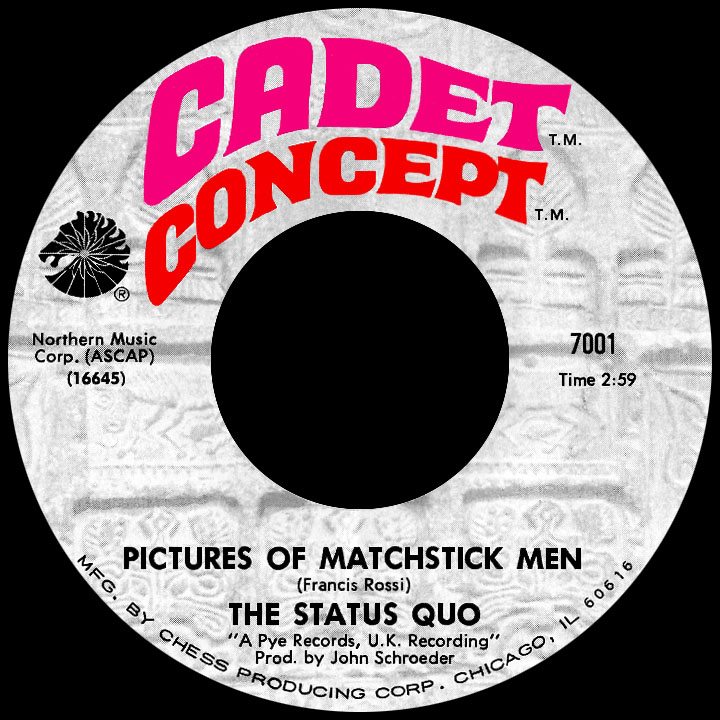
Pictures of Matchstick Men
One of the most sonically askew singles of the late '60s psychedelic period has to be "Pictures of Matchstick Men"...even the title hints at an image hard to fathom (unless you're familiar with a certain painter's work). Francis Rossi, guitarist and lead singer of The Status Quo, wrote the song during one of many excursions to the bathroom, not for the usual reasons but in an effort to block out the sound of his feuding wife and mother-in-law in the small flat they occupied. Even he couldn't explain some of the lyrics ('When I look up to the sky I see your eyes, a funny kind of yellow...'); the finished piece, however bizarre, was what pulled Rossi (who in those days used his third middle name, Mike) and his band out of the no-hit doldrums some six years after formation in Southeast London's Catford district. He pieced The Paladins together with secondary school pals Alan Lancaster (bass player) and Alan Key (drummer). The name was quickly changed to The Scorpions, keyboard man Jess Jaworski was added, John Coghlan replaced Key on the skins and by 1963 gigs, however sparsely-attended, got the quartet rolling as a performing band.
In 1965, Jaworski cashed in his valueless chips, keyboardist Roy Lynes joined and they took on another name, The Spectres. Signing with Piccadilly Records in '66, they embarked on a long association with producer John Schroeder. Two singles were issued that year, a rocking-yet-stilted version of "I (Who Have Nothing)" (originally a Jerry Leiber-Mike Stoller production-turned-hit for Ben E. King) and "Hurdy Gurdy Man," penned by Lancaster with Patrick Barlow or perhaps someone else using his name (a poppish tune, it bore no resemblance to the '68 Donovan hit you were just reminded of). Then the plan was to infiltrate the U.K. surveys with their third effort, an unpolished early '67 cover of the the American hit "(We Ain't Got) Nothin' Yet" by Blues Magoos. None of these attracted much attention.
Another moniker modification was in the works; with band names ending in "s" seemingly on the way out, they opted for The Traffic Jam and released a Barlow-Rossi song, "Almost But Not Quite There," considered their strongest effort to that point. Rhythm guitarist Rick Parfitt (who after a shaky start would go forward as one of the band's longest-tenured members) joined up and as a quartet they clicked, at least by their own estimation. Then Rossi dazed out into the stratosphere (no doubt visible from the window in the "bog," as he called it), and came back with lines like 'I rush home to bed, I soak my head, I see your face underneath my pillow.' The title came after gazing at wallpaper he thought looked similar to Manchester-based L.S. Lowry's "Matchstick Men" (or "Matchstalk") paintings. Yet the song's lyrics were downright hallucinatory, about trudging through a routine of seeing only two things, the "Men" and the object of his disparaged desire ('When will this haunting stop...your face it just won't leave me alone...'). The disturbing element was there, but what was needed was an appropriately oblique arrangement for the recording.
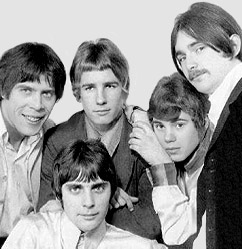
The band, and Schroeder, convened at Pye Records' Marble Arch studio in London's West End. Distorted "wah-wah" guitar effects and tape-delayed audio phasing (first heard on Miss Toni Fisher's 1959 hit "The Big Hurt") got them closer to the desired result, though Schroeder didn't approve of what he was hearing. Sometime prior to the release, the band decided on a new name that brought them nearer to the verve: The Status Quo. A track more in line with their earlier style, "Gentleman Joe's Sidewalk Cafe," was chosen by the label, but the band preferred the "Matchstick" side, so it was the one promoted to radio. Released on Pye (Piccadilly's parent company), it darted into the U.K. top ten in February 1968; a deal was made with Chess Records (primarily a blues and R&B label) for U.S. release on Cadet Concept (begun the previous year as an outlet for the rock market). In May, the single began its ascent and stations around the country gradually picked up on it; in August it reached a peak of number 12. The album, Picturesque Matchstickable Messages from the Status Quo, credited Rossi separately as both Mike and Francis, the latter by which he would henceforth be known. In the States the LP's Cadet Concept counterpart had two songs missing, with the title edited to Messages from the Status Quo. Neither charted.
The follow-up, "Black Veils of Melancholy," possessing a sound similar to its predecessor, had a brief mid-chart run in Britain that spring; it was passed over in America until the following year. The somewhat less-trippy "Ice in the Sun" ('...whenever she comes, I melt away...') returned the Quo to their home base top ten for a week in October while a brief low-chart run was all it could muster in the western world. "Technicolor Dreams" and spring '69 single "Are You Growing Tired of My Love" missed the mark entirely. In the U.S., nothing after "Ice" reached the charts. Not one thing they released. Singles or albums. Ever again. Adjustments were made to the group's style by the end of the '60s. Roy Lynes dropped out and the remaining four spent a few years in what has been called a "boogie band" phase, scoring U.K. hits as Status Quo (no more "the") with 1970's "Down the Dustpipe" and a few others (1968-era fans likely wouldn't have recognized them, audibly at least, during this time frame).
A complete transition occurred in 1973. Breaking ties with Schroeder, they began producing their own music. Signing with Vertigo, a record label known for its roster of hard rocking acts, they reached the U.K. top ten for the first time in five years with "Paper Plane," a driving guitar track from belated breakthrough album Piledriver (the first of 18 consecutive gold-certified Vertigo LPs in a row), paving the way for a more extreme succession of albums and singles, leading to large-venue concert settings in which they thrived, gaining millions of fans who for the most part couldn't care less about their '60s beginnings. "Caroline" rocked hard in 1974's U.K. top ten, "Down Down" hit number one in '75 and "Wild Side of Life" scored in '77. A handful of attempts at promoting singles in the States on A&M, Capitol and a few other labels proved pointless. For some reason they just didn't catch on anywhere in the Americas.
A long series of hit singles and albums, running well into the early 21st century, kept them rocking and going strong, ranking for much of that time as Britain's third most successful group (trailing the two you know so well, The Beatles and The Rolling Stones). Success on the other side of the world was apparently not a necessity. Why it played out like this is, frankly, a mystery. Francis Rossi continues as the leader and only remaining member of Status Quo. On the west side of the Atlantic Ocean, they're mainly remembered as the guys with that one unusual record from the summer of 1968 that went like this: 'Pictures of matchstick men and you...mirages of matchstick men and you...all I ever see is them and you...'