
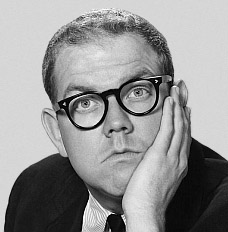
STAN FREBERG
There's little doubt the music industry's top-selling comedy-novelty act of the 1950s was voice actor and jazz fan Stan Freberg of Pasadena, California. After establishing himself in Hollywood's animated film business, his top-selling releases for Capitol Records spanned an entire decade and then some; he fearlessly criticized popular television shows, hit songs of the day (particularly rock and roll), political tomfoolery and a favorite target, Christmas, being highly critical of the modern-day merchants guilty of squeezing consumers of every possible penny during that so-called most wonderful time between Thanksgiving and each New Year. Later, he admitted to joining the other side, the money-mongers who created the ads that subliminally convinced Joe Average to part with his hard-earned wages.
He came into the world in 1926 as Stanley Victor Friberg, the son of a Baptist minister. A radio listener fascinated with comedic plays, as a youngster the idea of hosting and acting out skits became his passion; he gained experience as a helper to his uncle, Raymond Conner, who for a number of years performed as Conray the Magician. While a senior at Alhambra High School, Stan worked his way up the communications ladder, winning competitions in speech, debate and drama, and also put on a school variety show, playing all the parts himself. Soon he would embark on dual careers in radio and the film industry.
Immediately after graduation Stan, who'd changed the spelling of his last name to Freberg, approached a talent agency in Hollywood, which led to an audition with Warner Bros. and a regular, uncredited job voicing characters in Looney Tunes and Merrie Melodies cartoons alongside the great Mel Blanc; starting in the mid-1940s, he voiced characters like Hubie the Mouse (of Hubie and Bertie), Junior Bear (of The Three Bears), Tosh (of The Goofy Gophers) and the gullible, constantly-picked-on Pete Puma (a recipient of countless head-lumps), in addition to lesser-known characters like Grover Groundhog, The Gambling Bug, Chester (a dog), Willoughby (a dumb dog) and Benny (a cat). During this time, Freberg worked with prolific voice actress June Foray, who would eventually be a regular player on his popular singles.
Within months of his debut in the Warner shorts, Stan invaded the radio dial. Fiddler Cliffie Stone had a morning radio show, Coffee Time at Harmony Homestead, on Pasadena's 1110 KPAS (which took the call letters KXLA starting in 1945). Colleen Summers (the future Mary Ford, who scored many hits with soon-to-be husband Les Paul), Merle Travis and Ernie Ford (whose "Tennessee Ernie" character led to his eventual adoption of the name professionally), were members of Stone's house band. Freberg did lots of comedic voices on the show; while his radio career was taking off, he continued working behind-the-mic at Warner Bros. If all that wasn't enough, he began moonlighting at the Walt Disney, MGM and Walter Lantz studios and found time to supply radio's Jack Benny Program with a few wacky characters.
Stan's induction into the Army later in '45, just after World War II ended, limited his opportunities for the next two years. Afterwards, he composed a few songs for Stone including "Take it Any Way You Can Get It," followed in early '48 by some hysterical sobbing near the end of "Wabash Blues," credited on the Capitol Americana 78 as Cliffie Stone and his Barn Dance Band with Crying by Stan Freberg. Meanwhile, WB animator Bob Clampett had an idea for a TV series, Time for Beany, which became a live-action puppet show starring a beanie-cap-wearing child voiced by up-and-coming actor Daws Butler, with Freberg voicing sidekick Cecil the Seasick Sea Serpent and villain Dishonest John; the series ran for four years, winning three Emmy awards (out of four nominations) in the category Best Children's Program (in addition to a Best Actor nom for Freberg in 1951). In the early '60s, the show was revived (without the participation of Stan or Daws) as an animated series, Beany and Cecil.
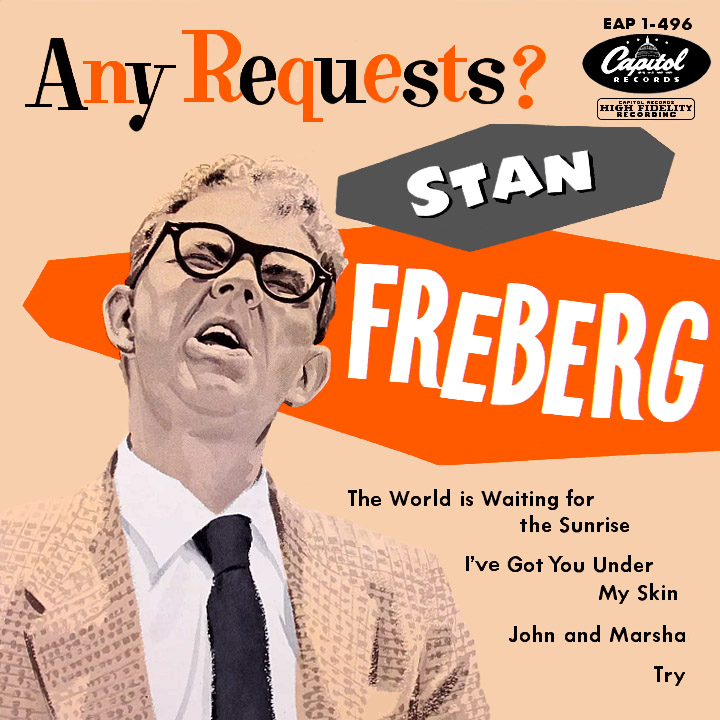
Capitol Records signed Freberg to a contract in 1950 and his first single was a hit. "John and Marsha," a takeoff on radio soap operas featuring schmaltzy violin music and the two names repeated throughout with comedic inflections (both parts by Stan), reached Billboard's top 30 in February '51 and became a running gag among fans both amateur and professional. Next he demolished Cole Porter's 15-year-old "I've Got You Under My Skin," playing a choir director whose reading of the lyrics, with many errors, is repeated verbatim by the singers. These back-to-back top 30 hits had listeners questioning their sanity while clamoring for more. But first, he appeared in the 1951 comedy film Callaway Went Thataway starring Fred MacMurray and Dorothy McGuire.
As his reputation expanded, it seemed few celebrities were safe from being roasted by this new master of parody. "Try," a top 20 hit in the spring of 1952, took Johnnie Ray's chart-topper "Cry" to a contemptible level of ridicule as Stan screechingly butchered the singer's emotional style (in the film Geraldine, released the following year, Freberg portrayed a character based on Ray). He made a brief detour into children's records in 1953 with a single "approved by Bozo the Clown": the story of young a singing elephant, "Dinky Pinky." Before the year was out, he would find himself sitting on the top of the charts with a million-selling police show parody...set in the middle ages?!
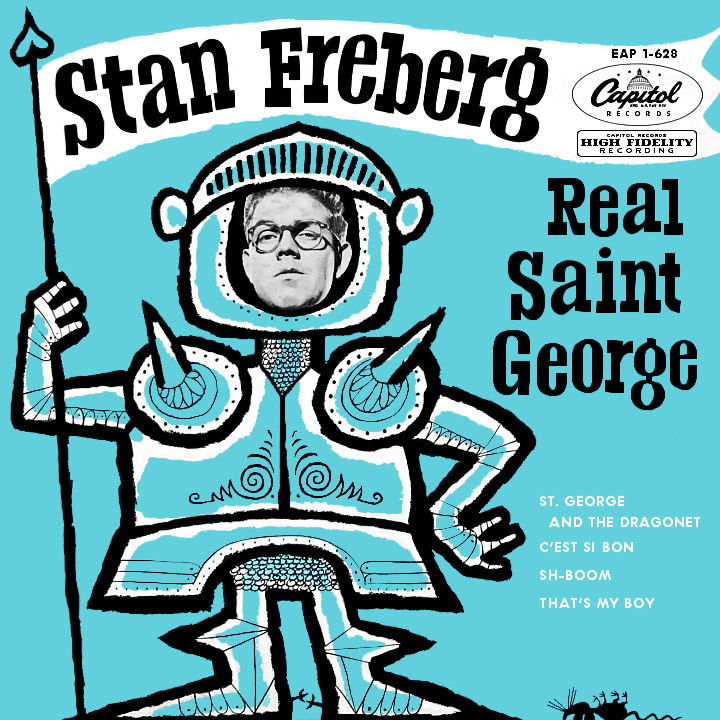
Jack Webb's famous Dragnet series had begun on radio in 1949 and transitioned to an NBC-TV series in 1951. Webb's take on police department crime solving (insisting on getting "the facts" using a monotone delivery as Sergeant Joe Friday) struck a chord with viewers and quickly became one of early network television's most-watched prime time series. So naturally, Freberg figured it was ripe for ridicule. "St. George and the Dragonet" (its source a folk legend, St. George and the Dragon, dating back several centuries) freely used the four-note Dragnet opener and theme (composed by Walter Schumann), setting the inner city detective concept in a medieval countryside. With Freberg (as St. George) and his acting cohorts (alas, uncredited), victim/maiden June Foray ("He breathed fire on me!") and Daws Butler in multiple roles including the dragon ("You'll never pin that rap on me! Do you hear me, cop?"), the session for the recording (done live in the studio) took many takes due to the musicians' inability to keep from laughing. Once released, reaction from radio listeners and record buyers was immediate; in October (with bandleader Ray Anthony's "Dragnet" theme, also on Capitol, already in the top ten), Freberg's single (a "dragon-net" being the plan for capturing the one-eyed scoundrel) leapt to number one and became a million-seller within a few weeks. Even Jack Webb was a fan!
The flip side, "Little Blue Riding Hood," furthered the Dragnet gimmick (again using the iconic theme music) with Stan playing Sergeant Wednesday this time, bumping into Chicken Lickin, meeting Blue Riding Hood in the woods (carrying firearms in her basket), playing a "hunch" and busting her at Grandma's house for running a "goodies ring." This side was a hit in its own right. Milking the idea a third time, "Christmas Dragnet" was issued as a two-parter running nearly seven minutes; Wednesday and partner Frank Jones arrest a guy named Grudge for not believing in Santa Claus, then commence to straighten out the green onions/scallions debate (we've all been there, right?) with a heightened repetition just like the show (did I mention Webb wasn't offended?). The record was so popular it was rereleased in successive seasons as "Yulenet" (presumably to sell copies to people who'd already bought it, a trick Santa probably wouldn't approve of). Another seasonal hit came in 1955; "Nuttin' for Christmas," one of several popular versions, ended with the kid (Stan) and a burglar (Daws again) doing a duet ("...why not?") on the chorus.
Over the next few years, Freberg frequently parodied popular singers and their biggest hits. He'd already taunted Johnnie Ray and followed it with a Les Paul and Mary lambasting a la "The World is Waiting For the Sunrise" with hyperactive banjos. Then there was a mangled "C'est Si Bon" even harder to understand than Eartha Kitt's hit version would be to someone who doesn't speak French. A number of star performers were chastised between '54 and '57, including The Chords and Crew-Cuts of "Sh-Boom" fame, suggesting they "gotta talk unintelligible" (like Marlon Brando) so no one will know what they're singin' about. He offered no mercy to Platters lead Tony Williams' vocal style on "The Great Pretender." In the mid-'50s it became obvious that rock and roll was one of his pet peeves.
Taking on Elvis Presley's sudden fame, Stan's cover of "Heartbreak Hotel" (the song that had blown the singer's career wide open in 1956) attempted to dismantle Presley's developing career with exaggerated voice echo, hiccups and a wardrobe malfunction ("ripped my jeans...third pair today!"). Calypso king Harry Belafonte's "Banana Boat (Day-O)" buckled under Stan's demand to "sing it softly." The Stan Freberg Show ran on CBS radio in the summer of 1957 with Butler, Foray and Peter Leeds joining the fun. Hitmaking bandleader and TV variety show host Lawrence Welk wasn't immune to the satirist's barbs; Freberg and his radio cast did a "Wun'erful, Wun'erful!" bit and in-studio response led to the routine being expanded and recorded. Welk's "Bubbles in the Wine" machine goes awry late in the two-sided, seven-minute routine, resulting in the studio/ballroom "lathering up with bubbles" and being submerged in the water beneath the Santa Monica Pier. Welk himself didn't care for it!
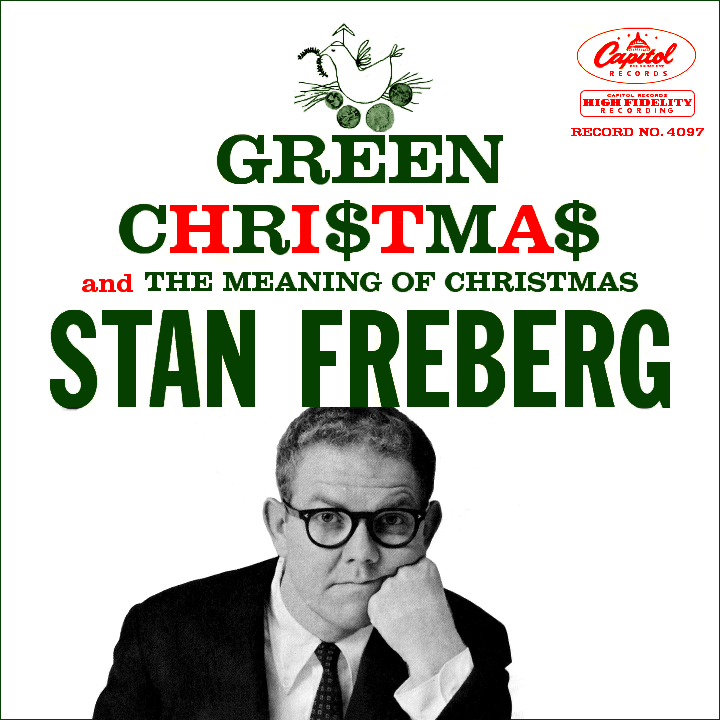
Adding to his list of voice work on radio shows, Stan starred in Alibi Me, an April 1958 episode of the long-running mystery series Suspense. Then before ya know it, Christmastime rolled around again! "Green Chri$tma$" brought up certain seasonal practices that have remained in effect ever since: he criticizes Santa Claus for drinking Coca-Cola on billboards; one client runs "magazine ads showing cartons of cigarettes peeking out of the top of Santa's sack" (and this year he'll be smoking one)! The chorus chimes in: 'Deck the halls with advertising! Fa-la-la-la-la-la-la-la-la...'tis the time for merchandizing!' and Bob Cratchet comments: "The people keep hoping you'll remember. But you never do." Scrooge: "Remember what?" Cratchet: "Whose birthday we're celebrating."
Stan Freberg's work had become closely associated with Christmas recordings, but not the kind that tell of the birth of Jesus (as in "Silent Night," "O Liitle Town of Bethlehem" or "Away in a Manger," the only legit type of Christmas song), nor of the kind that celebrate the holiday's traditions, nor of the more brazen (and quite common) type of romantic song with a mere seasonal backdrop, but the thing that irked him most, the commercial aspect, as he aimed his barbs at those who see the season only as a way to make oodles of money. But the inevitable happened: you know, if you can't beat 'em, join 'em. The advertising agencies, and like that. He later used a Latin phrase for the blatant commercialism in which he ultimately participated: "Ars gratia pecuniae" (translated as "Art for money's sake").
Highlights from the radio series were released on an LP in 1958, The Best of the Stan Freberg Shows, which won him a Grammy for Best Documentary or Spoken Word Recording (no mention of its being humorous) in the award's first year, handed out in May 1959. In addition, he scored a nomination in the same category for "Green Chri$tma$" and two others for Best Comedy Performance: one for the album and another for the Christmas single. A fifth Grammy nod (though there were no further wins) appeared the following year for Stan Freberg with the Original Cast in Comedy Performance, Spoken Word. As for his new add-on career that launched shortly afterwards, he created hundreds of ad campaigns. Some of his best-known (mostly in he '60s) were for Chun King Chow Mein, Meadow Gold Dairy, Contadina Tomato Paste, Sunsweet Prunes, Butternut Coffee, Jeno's Pizza Rolls and Bekins Van Lines. Over the years, he won 21 Clio awards for excellence in advertising.
The Payola scandal (essentially involving record companies giving cash under-the-table to disc jockeys in exchange for airplay) became big news in late 1959. Allegedly more prevalent since top 40 stations had gained momentum, it led to congressional hearings. New York-based DJ Alan Freed was called to testify and ultimately became the scapegoat, losing his high-profile job and paying excessive fines. Jazz fan Freberg, who'd already sold scads of vinyl rock and roll spoofs, came up with one more hilariously hypercritical recording, "The Old Payola Roll Blues," a three-songs-in-one, nine-minute brouhaha describing a mock attempt at pay-for-play. Jesse White (an alum of Callaway Went Thataway) played Obscurity Records owner Barney Schlock, the producer of a sub-par recording (like all rock and roll records, right?), by picking the first teenager he sees on the street (his name: Clyde Ankle) and making a record with him, "High School Oo-Oo" backed with "I Was on My Way to High School," each reaching a new low in musical affrontery. Tone-deaf Clyde (played by Stan) asks "Do I get to pose beside a tiger?," insinuating that he might be based on recently-risen teen idol Fabian. On the disc's flip, White approaches a hep-cat DJ (Freberg again), who shows him the door, then nods to Billy May (who has his orchestra at the ready!) and launches into "Goodbye, Obscurity Records," a swinging tune needing no payola to get played. We assume.
While it wasn't a huge hit, reviews of the record were largely positive. NARAS granted Stan a sixth nomination for "The Old Payola Roll Blues" in yet another slightly-renamed category, Best Comedy Performance, Musical. The seventh and eighth Grammy nominations were for an ambitious undertaking, Stan Freberg Presents the United States of America, a two-volume project made up of segments depicting events in U.S. history. Released 35 years apart, in 1961 and 1996 (the first album primarily covering the country's Revolutionary years and the second moving through the 19th century and into the early 20th), both featured musical conductor May and longtime friend and associate June Foray. In addition, Stan hosted the Grammy Awards' televised ceremonies (on NBC, May 12, 1964 and ABC, February 29, 1968) to positive reviews.
The hit singles heyday had run its course; voice parts in a few major films (notably as a beaver in Disney's Lady and the Tramp in '55) were followed in the '60s by an acting role in the big-budget, all-star hit comedy film It's a Mad, Mad, Mad, Mad World and guest parts in '60s small screen series like The Monkees and The Girl From U.N.C.L.E. TV and radio advertising was his main focus for many years. While hailed as one of the greatest satirists of the 20th century, Stan Freberg began keeping a lower profile, yet continued utilizing his talent on numerous projects from the 1970s through his death at age 88 in 2015.
NOTABLE SINGLES:
- Wabash Blues - 1948
by Cliffie Stone and his Barn Dance Band with crying by Stan Freberg - John and Marsha - 1951
- I've Got You Under My Skin - 1951
- Tele-Vee-Shun - 1952
- Try - 1952
- Ba-Ba-Ball and Chain - 1952
- The World is Waiting for the Sunrise - 1952
- Dinky Pinky - 1953
- St. George and the Dragonet /
Little Blue Riding Hood - 1953 - Christmas Dragnet - 1953
with Daws Butler - C'est Si Bon - 1954
- Point of Order - 1954
with Daws Butler - Sh-Boom - 1954
with the Toads - The Yellow Rose of Texas - 1955
- Nuttin' for Christmas - 1955
- The Great Pretender - 1956
- Heartbreak Hotel /
Rock Island Line - 1956 - Banana Boat (Day-O) - 1957
- Wun'erful, Wun'erful! (Side uh-one) /
Wun'erful, Wun'erful! (Side uh-two) - 1957 - Gary, Indiana - 1958
- Green Chri$tma$ - 1958
- The Old Payola Roll Blues (Like the Beginning) /
The Old Payola Roll Blues (Like the End) - 1960
featuring Jesse White - Comments for Our Time - 1960
with the Music of Billy May - The Flackman and Reagan! - 1966