
PATTY DUKE
Don't Just Stand There
One byproduct of Patty Duke's acting career, an attempt at turning her into a hitmaking "teen idol," ranked very low among her own personal priorities. For one thing, she wasn't a particularly good singer (her opinion, not necessarily mine, though she was certainly no operatic nightingale). Young stars making records (sometimes being forced to) was just something that was done in those early years of network television to appease agents working the angles when promoting their clients, or producers attempting to inflate their product (following a lead established by Ricky Nelson, Johnny Crawford, sitcom siblings Shelley Fabares and Paul Petersen and several others who were less successful). In the case of Anna Marie Duke (born in 1946, a Broadway star at 13, Academy Award winner at 16), it's the part of her resumé that seems to get the least acknowledgement. And...rightfully so?
Elmhurst, Queens, mid-1950s. One brother, one sister, an alcoholic dad prone to outbursts and a despondently boozing mom...the kind of situation small children shouldn't be exposed to. Turns out showbiz agents John Ross and wife Ethel, who specialized in grooming child actors, took her under their business-based guardianship (against her, but not her mother's, will) when she was eight. Within a year, in 1956, she began getting cast in bit parts on television under a new first name, Patty...despite her protests. She appeared in anthology series like Armstrong Circle Theatre, Dupont Show of the Month, Kraft Television Theatre and The United States Steel Hour, with substantial single-episode roles increasing over the next couple of years in addition to theatrical films like Country Music Holiday and showbiz drama The Goddess.
In February 1957, William Gibson's play The Miracle Worker made its first appearance on an episode of Playhouse 90 starring Teresa Wright as Anne Sullivan (who, starting in 1887, had taken on the arduous task of being the sole teacher to a severely disabled child). Patty McCormack was the first to portray the deaf and sightless seven-year-old Helen Keller. In 1959, nearly three years later, Patty Duke was cast in the Broadway production of the drama (the real Keller was age 79 at the time), which also starred Anne Bancroft as Sullivan. For both actresses it was surely the most challenging project of their lives. Bancroft won a Tony Award in 1960 for Best Actress in a Play. The completely focused, 13-year-old Duke, who was good at blocking out sights and sounds while onstage, inhabited the role in ways that left audiences stunned, though she failed to gain a Tony nomination (she did, however, win the prestigious World Theatre Award for her performance).
She made an unusual move (for a young actress) and became a contestant on a game show, putting her knowledge (and spelling skills) to good use on The $64,000 Challenge, walking away with $32,000 in prize money (most of which was taken by the not-quite-13-year-old's manager/guardians...and the IRS, of course). This and several similar CBS and NBC shows were implicated in accusations of planning the outcomes and supplying contestants with answers; Tic-Tac-Dough, Dotto, Twenty-One, The 64,000 Question, its Challenge spinoff and other shows were canceled. Patty found herself in the middle of it all, ultimately admitting her compliance, a stressful situation for someone her age.
In 1962, Bancroft and Duke reprised their roles in the big screen Miracle Worker (Arthur Penn, who'd directed both previous versions and had won a Tony for the Broadway show, was once again at the helm). On the Oscar broadcast of April 8, 1963, both were winners (Bancroft for Best Actress and Duke in the supporting category). A nearly-tearful Patty said just two words when accepting her award: "Thank you." Despite being established as a dramatic actress in this and The Power and the Glory, a TV movie with Laurence Olivier, she was approached by TV producer Sidney Sheldon, who was interested in creating a prime time sitcom for her. What he came up with was a gimmick where she played two parts: Patty Lane, a "typical" American teenager, and Cathy from Scotland, her more studious, straightlaced "identical cousin" (not a real thing, at least no cases have ever surfaced). The concept was inspired, at least in part, by The Parent Trap, a recent hit Disney film starring Hayley Mills as identical twins. Sheldon saw something in Patty, two sides to her personality if you will, not realizing at the time that she had a disorder not yet diagnosed.
For its star, The Patty Duke Show (which aired Wednesday evenings on ABC-TV starting in September 1963) was a chance for the five-foot-tall lead to have fun with the dual roles (actor William Schallert also played twin dads). The show's catchy theme (sung by a chorus) went like this: 'Meet Cathy who's lived most everywhere, from Zanzibar to Barclay Square...but Patty's only seen the sights a girl can see from Brooklyn Heights...what a crazy pair!' But: '...they're cousins, identical cousins all the way...one pair of matching bookends, different as night and day!' As if this weren't complicated enough, in one later episode she portrayed a third identical cousin, southern blonde Betsy Lane. Patty received an Emmy nomination (Best Actress in a Series) for the show's first season.
Then came a not-so-accidental tryout: on a March '64 episode she wound up in a talent contest singing "Tell Me Mama" (a song released on United Artists Records the previous year by "Triangle" girl Janie Grant). While Patty's singing left something to be desired, it was good enough to convince United Artists producer Gerry Granahan (one of the song's composers) to arrange a contract with the label. The song from the show wasn't released, though a version by 16-year-old Yorkshire, England-born Christine Quaite on World Artists (no connection to UA) spent two weeks on the Billboard chart in May.
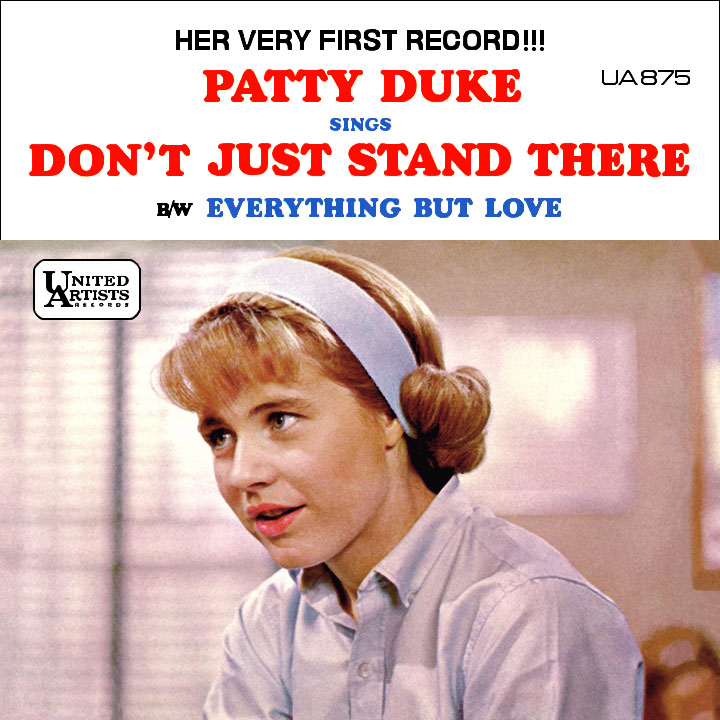
The show's producers, her management, the network...everyone wanted her to take the next formulaic step (like Mills and the others who'd sold scads of vinyl product before her). Never mind her vocal limitations and less-than driving desire to be a singer. The recording studio was conveniently located in Manhattan, just blocks from where the show was filmed. And...she scored a hit on the first try! Bernice Ross and Lor Crane, whose "White on White" had been a top ten hit for Danny Williams the previous year, worked their magic again with "Don't Just Stand There," a teenage exercise in self-doubt ('...tell me what, what, what...what's on your mind!') that put Patty on the charts in June 1965, just after the second season ended, and reached the top ten in August. The debut album, Don't Just Stand There, produced by Jack Gold with arrangements by Arnold Goland (who among other things had been involved in the creation of Phil Spector's infamous "Wall of Sound"), arrived in stores the following month.
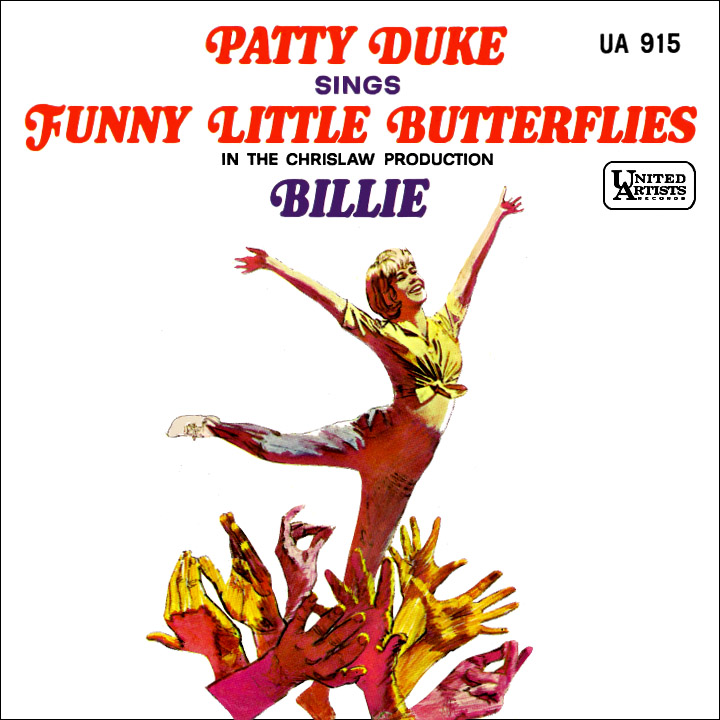
Shortly after the third season began airing, she...got married! Harry Falk, 13 years her senior and the assistant director of the series, was the groom. Her walk down the aisle may have been a symbol of love...or perhaps a way to free herself, at age 18, from the clutches of John and Ethel Ross, who lost control of her at that point. Sophomore single "Funny Little Butterflies" was a Crane-Ross-Gold tune from Patty's newest theatrical film Billie, a musical comedy about a high school girl who raises eyebrows by joining an all-male track team. The soundtrack LP featuring Dominic Frontiere's score was released and Patty/Billie's song spent several weeks on the charts in September and October. The flip side of the single, "Say Something Funny" ('...to me...everybody's watching!'), also contributed by Crane and Lor, was a bigger hit, nestling inside the top 30 in November. The third single, "Whenever She Holds You," reversing the gender on a Bobby Goldsboro hit from a couple of years earlier, pulled off a monthlong mid-chart run in February and March '66.
The Patty Duke Show continued as the gimmick became more routine. Its last original episode aired in April 1966. There were two singles released that year, remakes of Kitty Kallen's '54 hit "Little Things Mean a Lot" and George Hamilton IV's '58 hit "Why Don't They Understand," though neither was successful. A session with proven hitmaker Bob Crewe resulted in "The Wall Came Tumbling Down," a solid girl group-style effort that might have fared better, but it was put on the shelf and only a few promo copies exist today.
A surprising, almost shocking about-face occured when, little more than a year after Patty's sitcom had ended, she starred with Sharon Tate and Barbara Parkins in the film version of Jacqueline Suzanne's sordid-but-explosive best-seller Valley of the Dolls, playing Neely O'Hara, an alcoholic, drug-addicted actress. Critics weren't impressed with the movie, yet it was one of 1968's top three box office moneymakers. Co-star Tony Scotti performed "Come Live With Me" (penned by Dory and Andre Previn), which was recorded by Patty (but didn't make the soundtrack) and hey...her vocal performance was very good! An album, Patty Duke Sings Songs from Valley of the Dolls, followed; the hype in the liner notes mentioned "the excited voice of Patty Duke" (as opposed to an "exciting" voice). Ultimately it was Dionne Warwick who won the film's musical lottery with her million selling version of the title theme.
The final Patty Duke single came soon after: "And We Were Strangers" was slated for an unreleased LP, Patty Duke Sings Folk Songs: Time to Move On. And she agreed with the title: the time had come to just...stop singing. In a case of life imitating art, she developed bad habits: drinking heavily, taking pills and dealing with bouts of depression much like her Valley character, a habit that led to the end of her marriage in 1969. There were no films or appearances for an 18-month period; if indeed the "adult" role in her most notorious film damaged her career...and life...she redeemed herself with Me, Natalie, an independent film from the summer of 1969 about a capricious Brooklyn girl who relocates to Manhattan. Accolades for the movie and performance helped earn her a Golden Globe award for Best Actress in a Musical or Comedy.
The momentum continued with her first Emmy win for the 1970 TV movie My Sweet Charlie, followed by the birth, in February 1971, of son and future film star Sean Astin, then marriage a year later to Addams Family star John Astin, whom it was later revealed was not the biological father. Patty's career (she was known as Patty Duke Astin for several years) kept her busy in big- and small-screen productions, demonstrating over and over the thing she was very good at: acting. Two more Emmys were added to her mantle, for Captains and the Kings in 1977 and a remake of The Miracle Worker in 1980 (she took on Bancroft's previous role, Melissa "Little House on the Prairie" Gilbert played Helen Keller, and both were nominated for Lead Actress with Duke the winner).
Around that time, Patty was diagnosed with bipolar disorder, which had been suspected many years prior; she appeared on talk shows discussing her affliction and wrote a book about it, Brilliant Madness: Living with Manic Depressive Illness, published in 1992, one of three autobiographies she wrote throughout the years. There was one pet peeve similar to the short-lived Astin surname: following her marriage to Michael Pearce in 1986, she insisted on being known in her private life as Anna Pearce, while continuing to use the professional name Patty Duke until her death in 2016 at age 69. Today her 1960s recordings for United Artists are not what most people remember her for. But those hit singles and six albums' worth of material should be explored, though she might cringe at the thought of a resurgence in her relatively brief, uncomfortable music career.