
MEL CARTER
Hold Me, Thrill Me, Kiss Me
As soon as he was old enough to appreciate music, jazz became Mel Carter's preference. At least two of his mentors came from such a background; as a teenager in the mid-'50s he took singing lessons from Little Jimmy Scott who, like Mel, was a native of Cincinnati, Ohio. The diminutive Scott had been a singer for Lionel Hampton's band several years earlier. Later, Mel briefly worked with Quincy Jones. While these two accomplished members of the jazz community left an indelible mark on the young singer, it was not the direction he was destined to take...although he's occasionally utilized jazz stylings in a long career specializing in dynamic renditions of popular standards.
Once, at the age of six, he performed live on-the-air at Cincinnati's WLW-AM 700 during a popular radio program hosted by Betty Clooney (the younger sister of Rosemary Clooney, they'd both gotten their show biz break on the same station). Mel's school years became a time of waiting (and honing whatever skills he had) until finally, in 1959, he moved to the Los Angeles area. A lot of pavement-pounding followed until he got a shot with Arwin Records, owned by Doris Day's hubby Marty Melcher. "I'm Coming Home," a teen ballad by Janice Rado and the Sequins (written by Rado and later Beach Boy Bruce Johnston) was released on the Edsel label in the fall of 1960; Carter's cover came a year later on Arwin. Quincy Jones, who'd joined the staff of Mercury Records in 1960, was promoted to a vice president position within a year. Carter's Arwin record basically functioned as an audition disc and Jones was impressed, yet Mel's remake of Ivory Joe Hunter's eleven-year-old R&B hit "I Need You So" fared no better.
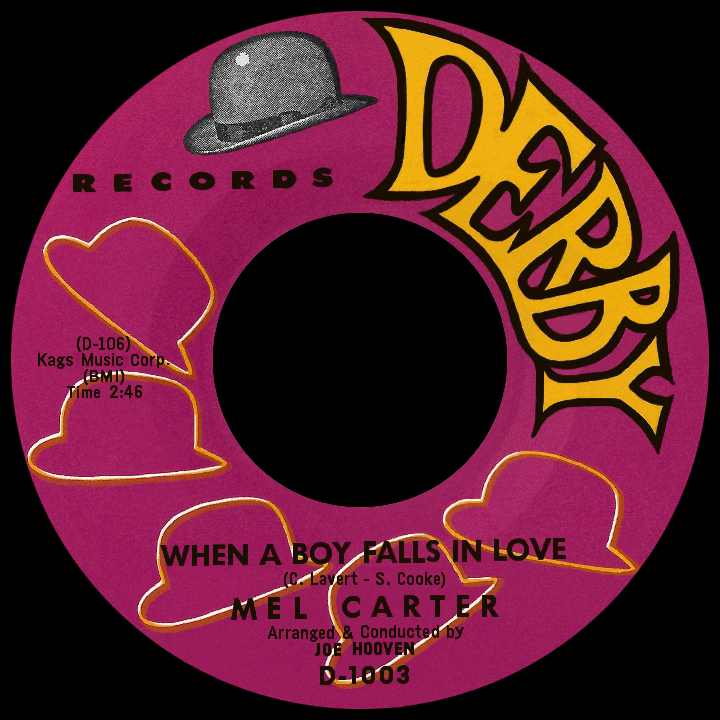
He recorded a duet with Dallas-born, L.A.-raised singer Clydie King, signed at the time to Mercury's Philips label. She'd been active since the mid-'50s (and was later a member of Ray Charles' Raelets); the label teamed Clydie and Mel on a bluesy tune, "Who Do You Love." Shelving his jazz dreams, he joined gospel great Robert Anderson as a touring vocalist; during this time he met Sam Cooke, who'd started his career with The Soul Stirrers and had made many friends in the world of gospel music. In 1963, Cooke's SAR Records operation spun off another label, Derby, and he signed Carter, giving him a song he'd written with Clinton Levert, "When a Boy Falls in Love." A sweet ballad that placed Mel on the charts for the first time, it was a mid-summer top 50 pop and top 30 R&B hit (Cooke also recorded a version that was released and charted in 1965, several months after his tragic death at age 33).
After two more singles on Derby, Mel began looking for a new label. While Cooke had become a close friend, he didn't want to stand in the way of any shot at success the young singer might have; in mid-'64 Mel signed with Imperial Records with the hope of making some jazz records. "Deed I Do," written in the '20s by Fred Rose and Walter Hirsch (a hit for Ruth Etting in 1927), brought him closer to his goal, but it didn't sell. Next came what might be called a "sophisticated soul" song, "The Richest Man Alive," which did well in and around Mel's Southern California stomping grounds, a precursor of what was to come. But there was one catch: the label's A&R directors would be choosing the material. He wouldn't be recording any more jazz numbers for Imperial.
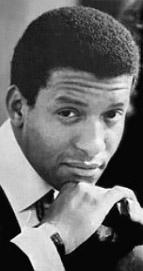
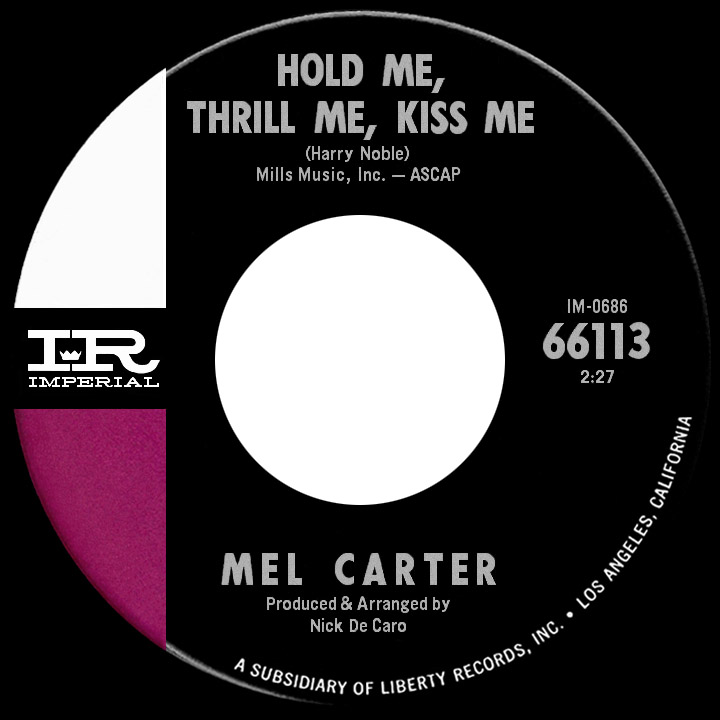
In late 1952, Karen Chandler (who'd gone by the name Eve Young in the '40s) had her biggest hit with the original top ten recording of New York-based singer-songwriter Harry Noble's "Hold Me, Thrill Me, Kiss Me." When the song was suggested, ahem, assigned to Mel Carter in '65, he didn't want to do it but agreed to give it a try once he realized R&B group The Orioles had stylishly covered the song in '53. He'd been offered a spot on Dick Clark's Caravan of Stars, scheduled to run from April to September. Many of the year's hitmaking American and British artists performed on the tour; Del Shannon, The Zombies, Jackie DeShannon, Peter and Gordon, The Drifters and Tom Jones were some of the top-billed acts. After a 30 day break in June he joined the second leg of the show, just as his thrilling "Hold Me" hit (which featured an exquisite orchestral arrangement by Nick DeCaro) gradually worked its way to a late August arrival in the top ten (and a simultaneous landing at number one on the Easy Listening chart) as the tour's final dates took place in several upper east coast cities.
The pattern was set. He had a solid run in '65 and '66 with several well-known standards from the previous dozen years: "(All of a Sudden) My Heart Sings" (a hit in '59 for Paul Anka), "Love is All We Need" (a 1958 entry in Tommy Edwards' string of hits), "Band of Gold," Mel's second Easy Listening chart topper in the spring of '66 (Don Cherry and Kit Carson had scored with their 1955 versions), "You You You" (The Ames Brothers, 1953) and "Take Good Care of Her," introduced by Adam Wade in '61 (Sonny James had just put out a popular country version). Then he reached back further for "As Time Goes By" (made famous by Rudy Vallee in 1931 and Dooley Wilson in film fans' forever favorite, 1942's Casablanca). Mel applied his own heartfelt vocal technique to these and other vintage songs.
He was switched to Imperial's parent label Liberty in 1967, but after two years the cycle had run its course. Later recordings for the Bell and Amos labels reached smaller audiences as his acting career launched with a small part as a "singing jailbird" in a November 1968 episode of ABC-TV's western series The Outcasts. A recurring role on CBS's long-running Medical Center lasted through 1971 and paved the way for one-shot appearances on shows like Sanford and Son, Good Times, Quincy, M.E., Magnum, P.I. and others as well as film roles in mostly-low budget films (Friday Foster, The Cat from Outer Space, Love is Not Enough) and a 1980s daytime soap (Santa Barbara), all while keeping busy with live performances and occasional record releases.
A career highlight took place in 1985 with a Grammy nomination for his album Willing in the category Best Soul Gospel Performance, Male (though the award went to perennial favorite Andrae Crouch). Since then he's kept busy on the performance circuit while releasing occasional albums that give fans what they enjoy most: classic songs rendered in the signature Mel Carter style.